
Believer's Baptism
Explained In Seven Biblical Metaphors
by
Book Cover & Preview Text
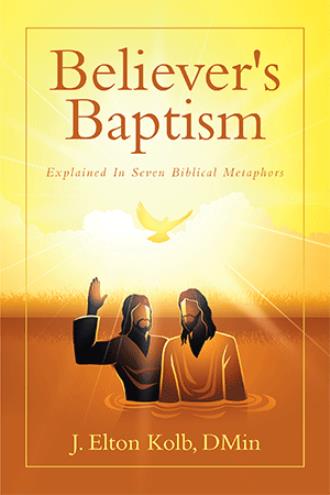
The booklet I wrote two decades ago and published in 2017 contained a thought that needed to be fleshed out. In the book, “Believer’s Baptism,” I named seven biblical images, or metaphors, which contribute to the meaning of baptism.
These images are:
1. The image of cleansing (Matt 3:11).
2. The image of re-birth (John 3:5-7).
3. A rite of initiation (Acts 19:5).
4. A rite of passage (1 Cor 10:1-2).
5. The image of covering (Gal 3:27).
6. The image of dying and rising again (Rom 6:4).
7. The image of being saved (1 Peter 3:20-21).
After consulting dozens of books, articles and other scholarly works on baptism, this exact approach was not found in any of those resources. Multiple metaphors were considered, but a primary metaphor was evident. It would seem that a multi-metaphor approach as a systematic means of teaching on baptism is an uncommon approach. Enlightenment thinking has kept us so focused on defending our territory that many have never stopped to survey the landscape. There are numerous anthologies and books by several authors, each contributing their own view of baptism. Some authors have stated that there needs to be a broader study of biblical meanings for baptism, and I have seen several resources that are an attempt at this, but most of them decidedly defend a particular view of baptism. There are, however, numerous lists of metaphors as meanings for baptism which are briefly stated to prove that there are multiple meanings, some of which will be examined here.
In Ashland’s Anabaptist archives I found a book which records the dialogue between Mennonite and Catholic theologians. It included an essay by Frederick Christian Bauerschmidt, a Catholic theologian writing the opening treatise on the subject of baptism. Bauerschmidt notes that most baptismal theologies center on a single metaphor and give cursory attention to other biblical metaphors. He names nine biblical images, two more than I named in my book. Thomas Finger, a Mennonite theologian responding to Bauerschmidt in the colloquium, affirms the presence of multiple meanings of baptism in the New Testament and summarizes Bauerschmidt’s list. A comparison of Bauerschmidt/ Finger lists of meanings with my own shows that there may be as many as nine or ten metaphors or meanings in scripture.
Another older source which may have influenced Bauerschmidt but which does not exactly match his thinking, is a list of meanings of baptism in Faith and Order Paper No. 111 of the World Council of Churches also titled Baptism, Eucharist and Ministry (hereafter called BEM). The BEM is an important document which represents decades of conversation facilitated by the World Council of Churches and which has been influential in the thoughts of many authors. Much of the contemporary literature on baptism is written either directly or indirectly in response to BEM. The BEM lists nine “images,” seven of which correspond directly to those which I have mentioned in my book. Two more images appear which do not correspond to my list or that of Bauerschmidt.
It is validating to see that a multi-metaphor approach to explaining baptism is not entirely new or unheard of. There may not be many books that take the same approach as I have, but the concept is there. Though there are additional possible images from those that I observed, I have decided to stay with the original seven for the purpose of this book. The others will be mentioned as overlapping or correlating with other metaphors.
In this book, each chapter will focus on one of the seven metaphors. In each chapter we will look through the lens of that particular metaphor serving as the primary metaphor for baptism. We will look to see where the metaphor appears in scripture and what it calls to mind in the biblical context. We will also see where the biblical metaphor has influenced theology and the teaching of the church. Lastly, we will see, through a multitude of traditions and baptismal practices, how these metaphors have influenced our baptismal rituals, ceremonies and services.
It is my desire that this book be used by God in bringing the church together around this important subject. The original workbook is in the appendix of this book and is available for use without charge, provided that it is unaltered. It is also available online in a format where you can provide your own cover. For those who wish to translate it into another language, my only request is that you provide a copy of your translation so that I may make it available to others. I have no desire to profit from what is ultimately a tool for the spreading of the gospel, but to assist in seeing Christ’s great commission fulfilled. The purpose for using multiple meanings for baptism is to help the baptismal candidate to appreciate baptism as a “muti-faceted experience” which one can appreciate differently as viewed from different angles.
Formats

Book Details
About the Book
Publishing a book on baptism is fraught with difficulty. Most of the books on baptism are written from a particular theological perspective. Some of them represent multiple views on baptism; however, those views are represented separately by different authors. Virtually everyone writing on the subject has the agenda of defending their view of baptism and are entrenched in their own positions. Battle lines are drawn, preparing to defend differing positions.
This is not a book about how to baptize. This is a book about why we baptize. Baptizing rightly is not so much a matter of practice as it is a matter of purpose. Baptismal practices have changed with the times and seasons of the church age. They have been adapted to various cultures and modified according to physical and social climates. Yet the purpose of baptism remains as universal as the symbol of water.
The Bible uses multiple images, or metaphors, to describe baptism. This book uses seven of them to look at baptism from multiple perspectives simultaneously. A multi-metaphor approach to baptism is like studying an object in three dimensions. One must look at it from every angle. Through these insights, author J. Elton Kolb presents a new way to have conversations about baptism.
About the Author
J. Elton Kolb is a pastor, counselor, international speaker, and leadership mentor. He has MDiv and DMin degrees and has served for more than twentyfive years of ministry as a missionary, pastor, and counselor. Dr. Kolb is passionate about missions, leadership, and helping people grow in Christ.