
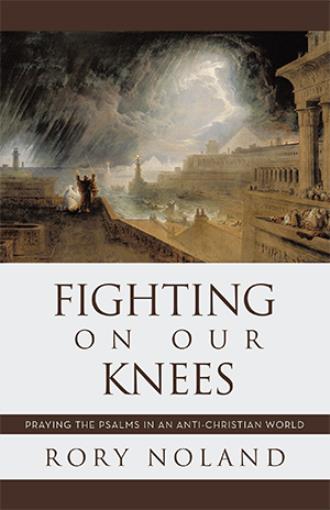
Fighting On Our Knees
Praying the Psalms in an Anti-Christian World
by
Book Cover & Preview Text
WHEN FOUNDATIONS SHATTER Psalm 11 Social commentators inform us that Americans today have an alarming lack of confidence in our nation’s foundational institutions. A poll published in October, 2023, by the Associated Press-National Opinion Research Center at the University of Chicago reveals that a third of Americans have “hardly any confidence at all” in the Justice Department. More than one in four (39%) have hardly any confidence in our executive branch of government. A whopping 95% have “only some confidence” or “hardly any confidence” in Congress.[1] A similar survey conducted a few months earlier also concluded that 45% of Americans have “little to no confidence at all” that our news outlets report the news fully, accurately, and fairly.[2] When people see that society’s major institutions are failing, they instinctively sense that their nation is falling apart. David, the author of Psalm 11, takes stock of all that’s going on in society in his day and deduces that it’s teetering on the brink of collapse. He struggles with knowing what to do about it and then offers a prayerful path forward, a path we would do well to emulate. God Is Our Refuge (v. 1) The main theme of Psalm 11 is summarized in its opening line. David simply announces, “In the Lord I take refuge” (v. 1a). His statement is in response to a serious, possibly life-threatening situation that’s been brought to his attention. Someone suggested to David that he escape the danger at hand by fleeing “like a bird” to some remote mountain (v. 1c). David, however, is abhorred at the thought of running away from his problems. “How can you tell me to flee?” he replies (v. 1b). He can’t imagine quitting just because things are difficult. John Calvin contends that if David were to run away it would demonstrate distrust in the Lord and would, in effect, be giving in to despair.[3] Instead of running away from hardship, David runs to the Lord and seeks refuge and safety in him. When the Going Gets Tough (vv. 2-3) . . . David’s advisor continues to paint a bleak picture of their predicament. He draws attention to a group of wicked people who are inciting trouble (v. 2a). In Scripture, “the wicked” refers to those whose values and actions violate God’s word.[4] The term typically applies to unbelievers, but it could also apply to those who call themselves believers and aren’t walking with the Lord. David reports that the wicked are bending their bows and setting their arrows against the strings (v. 2a, b). The imagery could be taken literally or figuratively. Israel could be under attack by a hostile army or the arrows could be a metaphor for the destructive, bitter words of an enemy.[5] Either way, these malicious adversaries are a dangerous threat. They intend “to shoot from the shadows” (v. 2c), meaning that they conspire in secret, work behind the scenes, to launch a surprise attack at any moment. Their target is “the upright in heart” (v. 2d), meaning true believers. They aim to strike a blow against those who follow the Lord and try to live rightly. Verse 3 discloses the seriousness of the problem as it proclaims that the foundations are being destroyed. The Hebrew word “foundations” alludes to established laws and customs that reflect a certain way of life in a society, the cultural norms upon which that society is built.[6] David realizes that there’s been a shift in the surrounding culture. The basic principles on which society is built—law and order—are disintegrating all around him; godly, humane values are quickly eroding; the world, as he knows it, is falling apart. Amidst these dire circumstances, David’s confidant cries out, “What can the righteous do?” (v. 3b). What can be done to stem the tide of lawlessness and injustice running rampant throughout the land? [1] “The Public Is Divided on McCarthy’s Removal As Speaker,” AP-NORC Center for Public Affairs Research, October 2023, https://apnorc.org/projects/the-public-is-divided-on-mccarthys-removal-as-speaker/. [2] “Americans Are Concerned About Threats to the Free Press,” AP-NORC and Robert F. Kennedy Human Rights Survey, May 1, 2021, https://apnorc.org/wp-content/uploads/2023/04/APNORC-RFK-Press-Freedom-Press-Release-Final.pdf. [3] John Calvin, Commentary on the Book of Psalms, vol. 1, trans. James Anderson (Bellingham: Logos Bible Software, 2010), 160-161. [4] Allen P. Ross, A Commentary on the Psalms, vol. 1, (1-41) (Grand Rapids: Kregel Publications, 2013), 339. [5] Ross, A Commentary on the Psalms, vol. 1, 340. [6] Ross, A Commentary on the Psalms, vol. 1, 340.
Formats

Book Details
About the Book
As modern society becomes increasingly secular, Christians today find themselves living in a world that is not only diametrically opposed to their faith, but also downright hostile about it. While living in what has been deemed an anti-Christian culture, characterized by a vehemently negative view of both Christianity and Christians, we are locked in a fight-to-the-finish battle with the forces of evil. Rory Noland calls and equips twenty-first century Christians to engage in spiritual warfare by praying the Psalms—the same book of prayers that ministered to the Israelites of old and served as their collective voice in turbulent times. He highlights a group of psalms that address three specific areas currently under spiritual attack—the family, the church, and the culture at large. Each chapter focuses on a particular psalm, presents a verse-by-verse devotional commentary, and concludes with prayer exercises based on that psalm. Throughout his presentation, Noland encourages Christians to stay vigilant in the all-important kingdom work called prayer. Fighting on Our Knees calls and equips Christians to engage in spiritual warfare by praying psalms that address three vital areas: family, church, and culture.
About the Author
Rory Noland is the director of Heart of the Artist Ministries and has served as a leader in church ministry for over forty years. He holds a doctorate in worship studies from the Robert E. Webber Institute, has taught undergraduate courses on the Psalms, and authored six books, including the bestseller, The Heart of the Artist.