
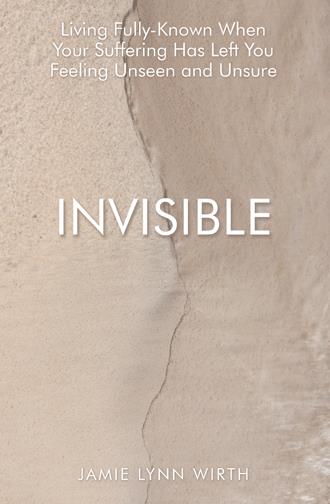
Invisible
Living Fully-Known When Your Suffering Has Left You Feeling Unseen and Unsure
by
Book Cover & Preview Text
Invisible suffering can leave us feeling misunderstood, because people have to choose to believe what is unseen rather than what they see. If only you could explain your situation to each person you meet to help them understand what is really going on. Then they
would know who you are, your intentions and the reality of the situation. Because saying “I don’t feel good” can be mistaken for “I don’t want to hang out with you”. Or taking a “day off” doesn’t mean sitting at home watching Netflix or going to the nail salon; it means laying in bed, praying the pain would ease up so you can function. Or an extended lunch break doesn’t mean time to take a nap, it's actually fitting another doctor's appointment into your work day.
Invisible suffering means living with and being in pain←both of which no one can see. Existing with invisible suffering means that you hope people will seek to understand, but unfortunately you find that people assume the worst.
If only they knew…
Who were you before PTSD? Who were you before the miscarriage? Who were you before the divorce, before the head injury, before the diagnosis, before the medication, before the chronic pain, before the addiction? Who were you before life got hard?
There’s comfort in being understood by someone who knows where you were and where you are now. It’s like having a childhood best friend who you are still friends with in your 20s or older. You have grown up together and there is something so sacred about that. Knowing and loving someone through all of their stages. They know you when you are at your best and when you are at your worst. There is less to explain because they’ve seen it and lived it with you. They know you. There's a comfort in that. You get to just be and you know they are with you.
As new people come into your life, there can be grief in knowing that this person will never know who you were before you were tainted, hardened, pressed. If only they knew you before life got complicated and you became exhausted. If only they knew the carefree
you instead of the fear-driven you or the pain-driven you. If only they knew how hard you’ve been fighting to make your new circumstances work. If only they knew that making plans is not as simple as it sounds, because you don’t know how you will be feeling, but to them it looks like you are non-commital. Or how long you have been putting up with the pain, but you just can’t anymore. If only they knew how much you are balancing and how strong you have to be on the daily. If only they knew you were smiling on the outside, yet crying on the inside. If only they knew that “I’m good” means you are barely holding it together. If only they knew the old you, maybe this relationship would be easier and you would feel like less of a burden.
If only they knew that there was more than meets the eye.
Maybe the greater grief comes when you wish you were that person before all of this happened. You’re grieving the loss of the light that was once in you, because now it doesn’t seem to shine. You’re grieving that positivity is no longer your default. You’re grieving how simple life was before all of the appointments, changes, onset of symptoms. You’re grieving how your body had never experienced chronic pain. You’re adjusting to your new financial status because of all of the medical bills. And you're grieving the lack of fun you experience because money now goes towards imaging, tests, treatments and appointments. You’re grieving what you have had to miss out on or decline because you don’t feel good. You’re grieving what once was and what now is.
BUT
You look fine.
This is what gets confusing. Some days you are able to keep up, but it’s hard for others to understand when other days you can’t. Canceling plans means you’re a flake, rather than the truth that you’re dealing with a flare up. Certain places are too overstimulating because of the lights and noise, but your friends only hear that you are high maintenance because you want to change plans. You had to call out sick again at work and your coworkers think you’re lazy and have a poor work ethic. It’s confusing because what once was a new pain is now your normal pain. When you live with chronic pain, you learn to adapt and live with pain to a certain degree.
Formats

Book Details
About the Book
“Nobody understands what I am going through..”
Pain is an interesting phenomenon—everyone experiences it, feels it, is shaped by it and yet the majority of the time no one can see it.
Is this my new normal?
Have they forgotten about me?
Should I just pretend like everything is fine?
Are they tired of hearing about it?
Does anyone actually understand or care?
When will this end?
When we feel overlooked or insignificant by the people around us we can assume God doesn’t see us either. In Invisible, Jamie Wirth welcomes us into her brain injury to acknowledge our longing for connection, our hope to be understood and our desire for validation. However, instead of expecting others to know everything about us, we can look to the One who already does. Whether you’re the one suffering or you’re watching your loved one suffer—Invisible explores how we can rest and be secure in our earthly relationships, regardless of circumstances, when we believe we are fully known, seen and understood by our Heavenly Father.
About the Author
Jamie Wirth was the very first patient to go through Oregon Health and Science Universities concussion rehab program. After two years of enduring second impact syndrome, Jamie found her passion to advocate for those who fall through the cracks. Since 2010, through several news outlets and a non-profit organization called Think First Oregon—Jamie has shared her story to encourage thousands throughout her home state Oregon. While she loves writing, volunteering and enjoying the outdoors in the Pacific Northwest, Jamie is a full time preschool teacher and also owns a wedding coordination business. Regardless of the roles she is in, her mission is making sure people feel seen and known by God.