
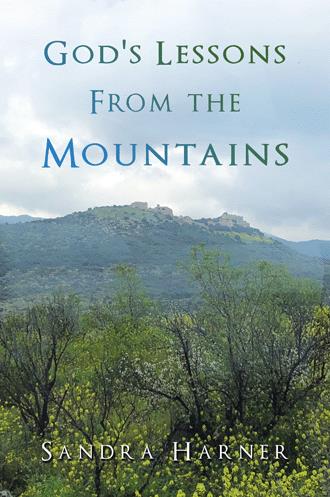
God's Lessons From the Mountains
by
Book Cover & Preview Text
“Take your son, your only son Isaac, whom you love, and go to the land of Moriah, and offer him there as a burnt offering on one of the mountains of which I shall tell you" (Genesis 22: 2). This is the child that Abraham and Sarah had waited and yearned for—the child that was to fulfill the promise of God. Humanly speaking, we can't even imagine what Abraham must have thought when he heard God's command. But we have no record of Abraham begging God to change his mind. We have no record that Abraham even hesitated. On the contrary, he got up early the next morning, saddled his donkey, and took two young men with him—and his son Isaac. He cut the wood for the burnt offering and left for Mount Moriah as God commanded.
It was a three-day journey to the mountain, and when Abraham could see the place from afar, he said to his young men, "Stay here with the donkey; the boy and I will go over there and worship and come again to you" (Genesis 22:5). Don't miss this important fact: he said, "The boy and I will come again to you." Abraham fully believed that Isaac would return with him. Perhaps he thought that God would raise Isaac from the dead. Something had to happen because Abraham believed God's promise to him. And that's why he courageously did what God had asked. He remembered the Lord saying, "Nothing is too hard for God."
Isaac carried the wood for the offering, but Abraham carried the fire and the knife. As they neared Mount Moriah, Isaac said to his father, "Behold, the fire, and the wood, but where is the lamb for a burnt offering?" (Genesis 22:7). And Abraham demonstrated his great faith as he answered his son: "God will provide for himself the lamb for a burnt offering, my son" (Genesis 22:8).
When they arrived at where God had told him to go, Abraham built an altar, and he laid the wood in order. It's challenging to picture this. The Bible says he "bound Isaac, his son, and laid him on the altar, on top of the wood" (Genesis 22:9). What happened here? Did Isaac struggle? Did he cry out to his father? Did he try to run away? None of those things are included in the biblical account. We must assume that Isaac willingly laid down on the altar. How he must have trusted his father and his God.
The Bible does not tell us how old Isaac is when he goes with his father to Mount Moriah. However, most scholars believe that Isaac was in his late teens or early twenties. Isaac is referred to as a "lad" or na'ar in Hebrew. This noun refers to a male from infancy to a young unmarried adult. Isaac carried the wood up the mountain; he was no longer a small child but a strong teenager.
Abraham reached out his hand and took the knife to kill his son. I'm so glad this isn't the end of the story. No, Abraham hears a voice calling from heaven: "Abraham, Abraham!" What relief must have flooded his heart! He answered, "Here I am." And then the voice said, "Do not lay your hand on the boy or do anything to him, for now I know that you fear God, seeing you have not withheld your son, your only son, from me" (Genesis 22:12). Abraham looked up and behind him was a ram, caught in a thicket by his horns. Isaac comes off the altar; the ram is placed on the altar and offered as a burnt offering instead of his son Isaac—his only son whom he loved.
Formats


Book Details
About the Book
“As much as we love life’s mountain peaks, we can’t stay there. Life is lived in the plains and valleys, with the rub and hubbub of other folks” (Michael Wittmer, Foreword). This book will take you to some of the most important mountain peaks in God’s Word, explain what happened there, and then give you life lessons you can learn from that mountain. God did not tell us these mountain top stories just to entertain us or to explain the experience on the mountain. He told us these stories so that we might learn from them. God’s Lessons from the Mountains will teach you how to engage as a deeper student of the Bible, and grow in your Christian walk.
About the Author
Sandra Harner is a Professor Emeritus of Professional Writing and Information Design at Cedarville University. She taught there from 1981 until 2017. She is a frequent speaker at women’s retreats and seminars and is also co-author of the textbook Technical Marketing Communication, as well as author of When God Says Remember and When in Doubt, Pray, a women’s devotional.She and her husband, Donald, live in Xenia, Ohio. They have two children and three grandchildren.