
All Scripture Has a Journey
A Handbook of God's Preservation of the Bible
by
Book Cover & Preview Text
Preface The Bible The Bible is probably the most familiar book on the planet. Its annual sales are estimated to exceed those of any other book, perpetually. Whether it is a dust collector on one of your tables or dog-eared from continual reading, it is familiar to families around the globe. But how did the Bible become the Bible? What is the basis of its composition? Why are there two testaments? And what does a testament mean? How is it that the Bible has lasted as long as it has? Who’s responsible for putting it together; are there many authors/writers or one? Why was it written in two or three languages? How did English-speaking cultures get their translation? For that matter, considering all the existing translations of the Bible for people groups around the world, is there a way to know its original source? What’s this I hear about it being “inspired”? So many questions about one book. I was raised in a family where there was always talk about the Bible. Or more particularly, we read it and let it talk for itself. From childhood, my sister and I were taught to memorize many of its verses. (Another question: What’s a verse?) Let’s just say the Bible was very familiar literature in our household. We had many copies (even a few different English versions). By the time we were teenagers, each member of our household had his or her own copy. But even within our friendly environs of Bible reading, by the time I reached college, the variety of English translations (or versions) of the Bible was increasing rapidly. The choice of which English translation you used became the grounds for either nods of approval or the first volleys of cannon fire of unnerving debate. Which translation is the best? Then, as my academic life took me to seminary, I discovered yet another translation that was unofficially endorsed by the faculty and certainly used as the major English translation during my time there. It was a paradigm shift of translation for me and of great concern to my parents. I learned to tread lightly. In this chapter, I have raised more questions than might be possible for me to fully answer. Yes, I will touch on most of them, but that’s not my current goal. I raised these questions to paint some broad strokes on a canvas that will be multicolored if not multitextured. During my time in seminary, I not only studied the Bible, I also became familiar with its historical and even geographical contexts. I have long since graduated from seminary. However, my interest in the Bible’s history and historical context of theology has increased. In fact, I have read more books on that subject since I graduated than I did in seminary. This last statement only begs more questions. The aforementioned statements are not intended to be, “Look at what I’ve done.” Rather, I have become humbled by how much I didn’t and don’t know concerning the backgrond of the Bible. As part of my reading, I became more engrossed in not only the Bible’s historical context but in its historical theology. That is, what did biblical and church leaders understand about what they read? What is theology, and how does it differ from just studying the Bible as a book? How did different views of theology develop? How or did they change from century to century? Whose theology is better than the others? Okay, that is an almost impossible question to answer to everyone’s satisfaction. And just where, exactly, was the Bible in all this theological quandary? The Bible is the foundation of theological opinion. It is therefore critical to understand what copy/translation of the Bible was available to scholars, pastors, and teachers of the Word. Further, was the copy of the Bible a good rendering of the original manuscripts, that is, Hebrew, Greek, and even Aramaic? Further, was it available to all to read and profit? What journey did the “Bible” take alongside the development of Jewish history and of the church? That’s the quest I have in mind.
Formats

Book Details
About the Book
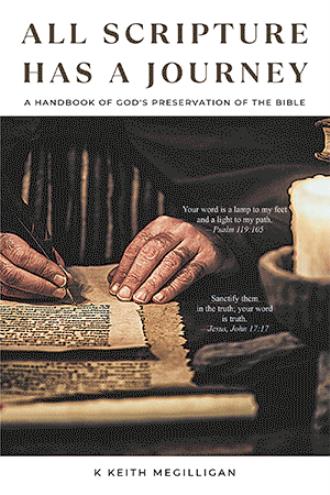
The Bible is the most familiar book on the planet. But how did the Bible become the Bible? What is the basis of its composition? What’s this I hear about “inspired”? Who is its author? Why are there two Testaments? What is a Testament? Is it true that it was originally written in two or three languages? How did we get the English version of the Bible? So many questions about one book! In All Scripture has a Journey, author Keith Megilligan presents the results of his lifelong query of how the Bible came to be. He addresses a host of question about its composition, history, “heroes” who helped along the way and the price that was paid to bring it to us. This handbook summarizes the English Bible’s journey from origin to publication. Whether the Bible is a dog-eared and well-worn leather bound book or the latest e-pub edition on your devices, that Bible has a journey. God, the Holy Spirit, superintended its origin and preservation.
About the Author
K Keith Megilligan has over 50 years pastoral and teaching experience. He has taught on biblical themes throughout the United States, fifteen international countries and over twenty-five times in Israel. He has served on several non-profit boards and been published in a variety of Christian magazines and journals. K Keith Megilligan holds the following: BA, John Brown University M Div, Th M, Grace Seminary D Min, Westminster Seminary (Escondido)