
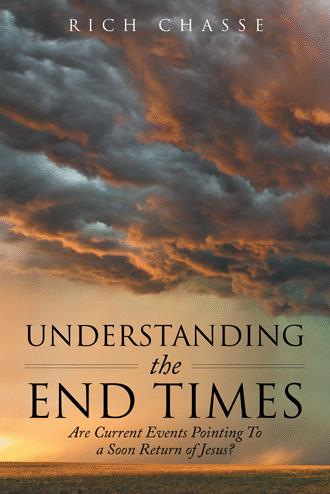
Understanding the End Times
Are Current Events Pointing To a Soon Return of Jesus?
by
Book Cover & Preview Text
INTRODUCTION
Here we are, another book on the End Times. Will this one be any different from much of the fare we see on the market today? Let’s start with what you won’t find in this book. You won’t find an unnecessary use of sensationalism. Many preachers and authors try to tantalize potential listeners and readers with sensational headlines about current events pointing to a “for certain” soon return of Christ. It might be about how prophecy warns of a pandemic as a sign that the Rapture may happen in a matter of months. Or how a conflict that erupts somewhere in the Middle East points to a potential harbinger of the return of Christ. Or it might be how a rising world leader could perhaps be the future Antichrist of the Tribulation. Or how the color of the moon provides some sort of clue as to the return of Christ. These kinds of statements are an abuse of the biblical view of the events surrounding the Second Coming of Christ. You won’t find those tactics used here.
This book presents a traditional Dispensational viewpoint of the End Times. We mention it here to let readers understand our viewpoint in presenting this study of the End Times. Now, you don’t have to know what that term means; I permit you to skip this part of the chapter if this confuses you. Just know that this is a time-tested view and holds to a high view of the Scriptures. For example, God made a promise to Israel through King David in 2 Samuel 7:16: “Your house and your kingdom will endure forever before me; your throne will be established forever.” We believe that God will fulfill that promise to Israel at the end of the Tribulation in the Millennial Kingdom. There are some who believe that the Church has taken the place of Israel in God’s design and that God’s promises to Israel will be fulfilled through the Church (Covenant Theology). But Dispensationalists believe that if God promised it to Israel, He will fulfill it to Israel. This is, admittedly, a simplistic presentation of the viewpoints. While this book’s purpose is not to make the argument for Dispensational Theology against Covenant Theology, we nevertheless stipulate there is much to be gleaned from both viewpoints.
As you make your way through this book, you will notice just how much the Scriptures are used to help us understand End Times events and timelines. This author believes the Scriptures hold the answers, therefore to the Scriptures we will go in the study of the End Times. In the process, we focus on the places in the prophetic literature of both Old and New Testament passages that are presented with clarity and certainty. We won’t take the time or space to speculate much on those portions of Scripture where it is more difficult to be certain or dogmatic. For instance, we won’t speculate on whether the locusts in Revelation 9 are literal insects or whether they represent military helicopters or something else. Most of the time, the answers to these kinds of passages are just speculation and guesses. On the other hand, when a phrase like, “the thousand years,” is used in Revelation 20, it is something that can more likely be understood in a literal sense because of how it is specific it is, how it is repeated several times, and because of how the context helps us to prefer a literal understanding.
Let’s go back to what is not another goal for this project. In this book, I do not intend to take a scholarly or academic approach to the subject of the Second Coming of Christ. First, I am not a scholar; nor do I play one on TV. I do appreciate scholars and experts in the realm of theology and Bible exposition. We need academics and scholars. But that is not the world I live in or serve. I am a local church pastor who hopes to speak to the local church. I want people in the pews, as they pick up this book, to be able to read and understand more clearly the issues surrounding the Second Coming of Christ. There is too much speculation and sensationalism on this subject already available. I believe if the average churchgoing, Bible-reading believer has more confidence in the subject of the Second Coming, the less those other speculative and sensationalized books, websites, and preachers will cause them to be uneasy, or even scare them.
The layout of the book is quite simple. There are five sections with three chapters in each section. Section 1 provides a foundation for understanding End Times events. Sections 2 through 5 tell the story of End Times events in somewhat of a chronological order. Section 4, which covers events from the book of Revelation, is a bit harder to understand from a chronological perspective. We’ll address the issue of timing in Revelation in chapter 11. Section 5 addresses the events at the very end of the Bible (Revelation 19–22). The last chapter deals with points of application. I believe that just knowing information is not enough. We must apply what we learn to how we live our lives.
My goal for this book is to make much of Jesus Christ. The reason for studying this subject is to have a better understanding of our Savior. Armed with a better understanding of Jesus allows us to be more effective in the ways we live and serve Him. Our devotion to Christ will only continue to grow. The compassion we have for those who don’t know Jesus will also continue to grow. The bottom line: All of this is for Jesus.
Blessed is the one who reads aloud the words of this prophecy, and blessed are those who hear it and take to heart what is written in it, because the time is near. (Revelation 1:3)
I encourage you to begin by reading through the “Glossary of End Times Terms,” which follows. This will be time well spent so that you and I can be on the same page in understanding some basic terms and ideas presented in prophetic literature. Are you ready? This is a fascinating subject. You might want to buckle your seat belt. The ride might get a little bumpy, but it will be worth it!
Formats

Book Details
About the Book
People are fascinated and sometimes terrified by the subject of the End Times and the book of Revelation. The topic can be disturbing. For some people it can even be scary. There’s a lot of misinformation out there. There are many teachers playing on the insecurities of people with End Times updates that stir up curiosity or fear, taking advantage of many as a result.
To understand how to approach the study of End Times events, we need to ask an important question:
Are current events pointing to a soon return of Jesus?
How we answer this question will influence how we view the rest of prophecy. It’s important to understand what goes into answering this question correctly.
When you turn on the news and watch events unfold, do you sense the tension? When you flip through your social media or the internet and look at all the things that are happening, does it cause you heartburn—or maybe heartache? Would you say we are in a unique time in world history? So, how do you answer the question?
We’ll answer that and more in Understanding the End Times: Are Current Events Pointing to a Soon Return of Jesus?
About the Author
Rich Chasse has been a teaching pastor for the past thirty years. He is also the host and teacher on the Bible study podcast Daily in the Word with Rich Chasse, which is available on most major podcast platforms or at the website, DailyInTheWord.info. Rich and his wife, Sherie, have three grown children and four grandchildren, and reside in Scottville, Michigan.