
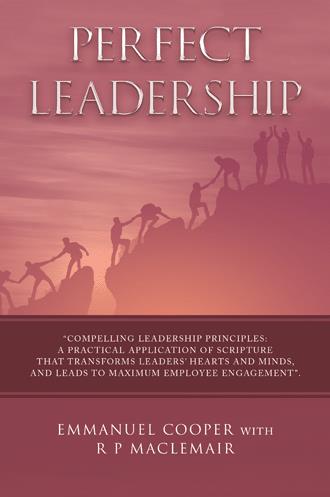
PERFECT LEADERSHIP
by
Book Cover & Preview Text
Much is written about leadership, and its many definitions. Consider the following example statements.
“We will achieve market leadership in a given marketplace”
“We are leaders in quality and reliability”
“The government will take the lead in providing social services”
“Industry will need to show more leadership is some particular cause”
I am sure you could think of many others.
In this book we want to focus on the leaders of an organization, how they lead, and what effect leadership policies have on followers and the organization. The organization might be a business, non-profit, college, hospital, or any situation where there is a leader and followers.
This book’s title, Perfect Leadership, on its face is audacious. How can leadership be perfect? Who even is knows what perfect leadership looks like?
Let’s examine the Gospel of John -
“In the beginning was the Word, and the Word was with God, and the Word was God. 2 He was in the beginning with God. 3 All things were made through Him, and without Him nothing was made that was made. 4 In Him was life, and the life was the light of men. 5 And the light shines in the darkness, and the darkness did not comprehend it.” [John 1:1-5]
In this scripture we learn that Jesus was with God from the beginning as the Word and always existed. Later in John we are told,
“The Word became flesh and dwelt among us, and we beheld His glory, the glory as of the only begotten of the Father, full of grace and truth.” [John 1:14]
That is, the Word became flesh in Jesus.
We will argue that perfect leadership must originate with the only person on earth who was described as perfect, Jesus.
“For the law appoints as high priests, men who have weakness, but the word of the oath, which came after the law, appoints the Son who has been perfected forever.” [Hebrews 7-28]
Highlighting the challenge of leadership, even with great training, we postulate a story. Mary, a rising employee in a medium-sized corporation, obtained an MBA at a reputable business school’s night program and is well-qualified to take over as leader of her group. Having earned that position, in the first few years of her tenure she was sent to several leadership/management seminars and workshops. Though she feels confident in her role, Mary still encounters situations which do not jibe with the management concepts she has been trained to employ. Despite all her preparation and experience, she often finds her efforts insufficient to overcome organizational obstacles.
As a senior manager at two Fortune 500 corporations, I could identify with Mary’s frustration. Having graduated from the University of Cincinnati with a degree in engineering, my aspirations and expectations ran high. These were quickly deflated in my first job where I observed controlling managers, lack of teamwork, and even sabotage! Individual achievement and career advancements were often pursued for the benefit of the leader’s personal goals and at the expense of corporate goals. Employees became demotivated.
Many employees around me seemed to be doing just enough to get by; others didn’t really cooperate with one another as a team; and still others were working well below their potential. I began to observe how different parts of the overall organization worked and how well they related to mine. Taken together, the parts of the business didn’t coalesce around building stock-holder wealth and at times the different units of the organization seemed to be competing rather than cooperating.
As an individual contributor, I began a lifelong search for why so many aspects of a given enterprise were dysfunctional. The list of concerns (24) was staggering.
Poor placement and development of talent.
Employees’ creativity relatively untapped.
Managers’ over-controlling situations, including going as far as re-doing 100% of employees’ work and/or directly performing the employees’ work.
Employee-to-employee, manager-to-employee conflicts remained unresolved even though there were many attempts to rectify them.
Serious mismatches between management’s goals and employees’ actions/behaviors.
Work was not exciting, TGIF!
Negative and often incorrect rumors resulted in as much as a 5% productivity hit.
Stress levels and the risk of failure very high.
Employees and managers taking their frustration home to families.
Unethical behaviors by management and employees; stealing, false reporting of travel expenses, sexual acts.
Individual goals trump group goals.
Employees and managers stealing other organizations’ ideas and claiming credit – sabotage of others’ efforts (can’t have them look better than me).
Discrimination against races other than white and genders other than males.
Minimal or no succession plans.
Incredibly poor communications, including no communications.
Management/leadership by fiat, anger, shouting, strong language, intimidation, etc.
Lip service given to many new processes and programs – no management commitment – efforts become the “program of the month.”
Talents go undeveloped.
Considerable confusion over the roles of leaders and managers and the importance of each.
Individual greed operating at all levels of business.
Management and leaders’ actions lead to losses in productivity and increased bureaucracy.
Ineffective and discriminatory handling of rewards and recognition.
Short term focus for planning – no vision and/or strategic plan.
Application of humanistic psychology.
Are we stuck with such dysfunctional issues? How did we get to be this way? Were people in leadership and management responsible for this mess? Was there a time when things were better, but somehow the culture has shifted?
From my search for the solutions to the 24 dysfunctional organizational issues, I found the best answers in the Bible. From Bible studies, consulting with business owners who applied the Bible, and my own experiences, Compelling Leadership Principles© were born.
These principles are based 100% on the Bible and teachings of Jesus. After all, the ministry of Jesus and His leadership style was most compelling, and worthy of emulation. The word ‘perfect’ in the book title “Perfect Leadership,” takes its meaning from Jesus as the only perfect one.
Formats

Book Details
About the Book
Faced with a difficult business turnaround, the author, 46 at the time, sought help from his pastor who connected him with Christian executives who were using the Bible to run their businesses. These contacts yielded a biblical foundation for leadership based on Isaiah 9: 6-7a. Three aspects of this scripture are very important – Son, Government and Promises. Son refers to Jesus, Government refers to how we lead, and the Promises are wonderful, counselor, mighty God, everlasting Father, and Prince of Peace. Acting on the advice of the Christian executives and his newfound way of understanding God’s Word, Mr. Cooper developed and implemented seven (7) Compelling Leadership Principles, applying them to the turnaround challenge. The holy grail of superior business results, employee engagement, was maximized. All business functions under Mr. Cooper’s leadership started to coalesce and create as never before and real teamwork was achieved. For example, the engineering team was awarded over 100 patents in 18 months! This book tells the story of how the principles were applied and details the amazing transformative achievements of the business and its employees.
Prior to developing this book, Mr. Cooper had completed an engineering degree and an executive development MBA in economics. Management experience included all conventional business components while working at several major corporations. As a student and practitioner of leadership he was always looking for the best way to lead his organizations. After leaving industry he taught in several colleges in Florida, North Carolina and Delaware. From his industry experience, especially the challenge to “launch a business in eighteen months or be let go,” he created a college course demonstrating the practical application of his Compelling Leadership Principles. Mr. Cooper continues to seek teaching opportunities and offer help to small businesses.
About the Author
R P Maclemair is a retired Civil Servant with 36 years of experience within various components of the Federal Government, focusing on the areas of Program Policy, Financial Management and Administration. Post retirement, he served as a Real Estate Settlement Attorney and Tax Professional. He also holds a Master of Administrative Science (MAS) and a Juris Doctor (JD) Degree. Active in Community affairs, Mr. Maclemair served as President of two Church Councils, two service organizations, a Community Chorus (which he founded), and an HOA Advisory Board. Prior to his collaboration with Mr. Cooper, he assisted in the preparation of three published novels and two manuscripts now in the editorial process.