
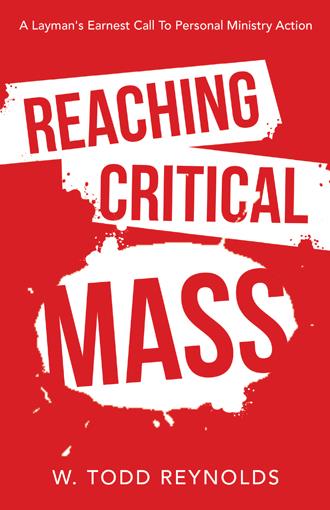
REACHING CRITICAL MASS
A Layman's Earnest Call To Personal Ministry Action
by
Book Cover & Preview Text
Introduction
Many civilizations have created their own versions of critical mass. In this introduction, I seek to address the
U.S. Christian’s version of critical mass. This critical mass is a
self–perpetuating, twenty–four–hour–a–day,
seven–days–a–week paradigm that leads us to believe that if we are the earliest to rise, first to the office, latest to clock out, play the hardest, and die with the most toys, we will have reached self–actualization. After all, isn’t that what makes us happy in life? This is the concept we are taught in classes such as biology, marketing, and economics.
The culmination of this nurture paradigm has brought us to the current–day state of critical mass. It is as follows:
• Acquire as many degrees of education as possible.
• Create as many storehouses of money as possible.
• Purchase the latest and greatest brand of vehicle.
• Keep up with our neighbors and friends by owning the next level of home.
• Maintain a country club membership with that home.
• Keeping the family entertained with a boat, camper, jet ski, or all three.
• Throw an occasional few dollars into the offering plate or give a couple of dollars to a homeless per- son to placate our conscience.
I am not writing this to judge those who have these possessions.
Possessions are a blessing from God. I admit that pursuing that next level was a part of my life. Our Lord and Savior Jesus Christ encouraged and rewarded hard work and investment. Matthew 24:14–30 finds Jesus telling the parable of the loaned
money. It is important to keep in mind that investment is
referenced in the Bible six times. The six passages address our time, abilities, resources, and lives to the work of Christ and for others’ needs. In 1 Timothy 5:8, Paul tells us if we do not provide for our families, we are worse than unbelievers. Since 1989, some of the above pursuits were on my agenda. Only two to three years ago, I found myself at an all–time–high body weight of 214 pounds with high blood pressure despite medicine, anxiety, and a transient case of depression. The stress and struggle of juggling it all came home to roost. The critical masses we have achieved in our society are massive heart attacks, strokes, bankruptcies, financial insecurity, divorces, and moral compasses spinning out of control as if they were affected by a magnet. In 1999, the Barna Research Group surveyed 3,854 people in forty–eight states and found that eleven percent were currently divorced and twenty–five percent had been divorced at least one time. Out of the same group, twenty–seven percent of those born–again Christians surveyed have been divorced compared to twenty–four percent from all other groups. In 2005, there were 542,000 bankruptcies. In 2006, there were 83,154 foreclosures. Foreclosures exploded to 168,829 in 2007. We wonder why eighty percent or more of our next generation of Christians falls away from the Christian faith when they leave high school and enter the workplace or hallways of colleges and universities.
Please do not misunderstand my motivations in sharing this information. These statistics are not representative of all Christians in the Unites States. However, the Christian community has a similar trend to our non– Christian counterparts.
I am convinced the future is bright. I am convinced the level of brightness is as great as the level of our obedience to the call of Jesus Christ. As Christians, we need to understand that there is a critical mass that is hurling towards us at a blinding speed, for which eternal possessions are all that ultimately matter. It is the critical mass of the return of God to establish his kingdom on earth. Our understanding of this critical mass comes from the original law of creation, the law of sin that permeated this world, redemption from that sin, our role in promoting reconciliation, and a biblical event that put our role into
motion. One underlying principle is the catalyst upon which this critical mass exists. The principle is: Dying to oneself in our perishable state, in order to, produce more things in the imperishable state.
Whether you are a Christian or the title of this book made you curious, I invite you to partner with me in exploring how we can shift our paradigm from a state of perishable to the state of the imperishable. After all, we do have the resources as common men and women through the grace of our Lord and Savior Jesus Christ to impact this perishable world at a level that no CEO could ever dream. It is our impact in this perishable kingdom that leads to the growth of the nonperishable kingdom.
Formats

Book Details
About the Book
IN JESUS CHRIST. YOUR LIFE HAS TREMENDOUS WORTH. WILL YOU ANSWER HIS CALL TO SERVE?
There is a desperate need in the world for the expansion of individual Christian ministry. In Reaching Critical Mass, author Todd Reynolds illustrates the many ways a Christian, young or old, can serve God upon mankind; gifts that ultimately must be brought into service of the Lord. Through the use of Scripture, learn the stories of some of God’s most faithful servants. From Paul to Rahab to David, the Lord has called many into his service. In Reaching Critical Mass, you, too, will see that you can answer the call.
About the Author
W. Todd Reynolds is the founder and President of Sonrise New Testament Ministries. Tod has a three-decade-long personal relationship with his Lord and Savior Jesus Christ. Since 1991, Todd has felt a calling to serve Jesus Christ above and beyond his local church. Until Jesus revealed his calling to Todd, he felt led to keep a spiritual record of how Jesus worked in his life. After fifteen years, Jesus Christ’s call in Todd’s life became clear. Todd was led to establish Sonrise New Testament Ministries. Without Todd’s unique life experiences, and the leading of the Holy Spirit, Reaching Critical Mass would not be available today. Todd’s passion for sharing the love of Jesus Christ with the people worldwide in their native languages, and the earnest call for other Christians to join in similar yet diverse ministries as a renewed lifestyle, is his lifelong commitment.
www.sonrisenewtestamentministries.com