
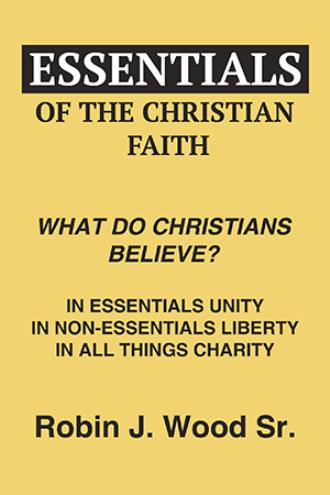
Essentials of the Christian Faith
What Do Christians Believe?
by
Book Cover & Preview Text
Filter Because of things like this and many other experiences and sermons, I’ve had to develop a filter for myself. I filter religious thought and behaviors through one of 4 categories: 1. Orthodoxy- Orthodoxy is defined as conforming to what is generally accepted as right or true, Essential, Foundational and Fundamental. Don’t get trapped in semantics. False teachers often use orthodox lingo. Dig deeper into their theology and you’ll find that their words don’t always have the same meaning as ours. Words like: God, the spirit or the savior can have a vastly different definition than traditional Christianity. Besides that, we live in a post-Christian America and situational ethics is the daily fare. In situational ethics right and wrong depend upon the situation. In today’s world we call it “wokeness” or being “woke”. Before too many years this term will probably be obsolete and I’ll sound like a hick. Another popular buzz phrase uses “Your Truth”. Truth is not subjective. Biblical orthodoxy means it is accurate from the perspective of a Biblical World View. It must be based upon “All Scripture.” 2 Timothy 3:16-17 NIV says: All scripture is God-breathed and is useful for teaching, rebuking, correcting and training in righteousness, so that the servant of God may be thoroughly equipped for every good work. Paul is talking about the whole Panoply of scripture. Panoply means: “the complete collection of things”. To some sects, even their definition of scripture isn’t the same. They may or may not include The Bible as God’s authoritative and inspired scripture. False teachers add or delete books. They can even have their own home-grown versions of the Bible that they falsely call translations. Legitimate translations have been painstakingly developed by genuine scholars, not “in house” teachers with an unscrupulous agenda. These other “scriptures” are usually developed to support aberrant positions. I repeat, scripture must agree with itself in context with scripture. Paul referred to “The Whole Counsel of God” in Acts 20:27. NIV Genuine scripture must agree with the rules of “canon”; the measuring rod or ruler. We’ll discuss this in our talk on Essential Bible. 2. Non-Essentials- These are non-essential ideas that don’t color outside the lines of what is orthodox, but are non-essentials. They are often simply denominational convictions or traditions. They aren’t necessarily wrong. I have my own theological bent but I won’t be selling it because I don’t consider these beliefs to be essential to salvation or to Christian living. We can debate non-essentials but not divide over them. C.S. Lewis said: “When Two Christians start arguing, it is usually not too long before one asks where such and such a point really matters.” And the other replies: “Matters?” “Why it’s absolutely essential.” A 17th century Lutheran theologian said: “In Essentials Unity, In Non-Essentials Liberty, in all things Charity.” Don’t be confused though: ideas really do matter and subsequent actions have consequences, good and bad. 3. Aberrant Theology- An aberration is defined as “deviant”, “errant”, “strange”, or “unusual”. I’ve seen deviant, errant, strange and unusual doctrines and extra-biblical behaviors over the years; things that aren’t necessarily mentioned in The Bible. I’ve witnessed bad interpretations of one obscure scripture turned into whole movements and even world-wide denominations. In extreme sects these folks seem to love using Isaiah 43:19 as a catch all. “Behold I am doing a new thing.” Believe me, I’ve seen an awful lot of new things floating through the Body of Christ over the years. I’m taking some liberties here and trying to be generous by not calling aberrant teachings and extra biblical behaviors false teaching or calling proponents of them false teachers. Some Christians would. I wouldn’t call them non-Christians, but they have drifted into fringy, kooky beliefs and extra Biblical doctrines and behaviors. One minister, friend when describing a large Christian organization that fits this description says: “They are still attached to the trunk of the tree but are on the twig of a branch of a limb.” A five-dollar word for this is “Syncretism.” It’s mixing different non-Christian beliefs or practices with Christianity. You can’t mix oil and water. They never stay mixed. If you’ve identified your church as aberrant, you might want to get out and find a healthy church. Don’t try to change them. Missionary dating doesn’t usually end well. Like a gateway drug, more than often these groups morph into a cult. Some folks call them Christian cults. It’s easy to appear noble and become an appeaser and say:” Now don’t be divisive, we’re all brothers and sisters in Christ.” “It’s all about unity. Another poison is: “I choose to focus on our commonalities versus our differences.” Maybe so, but it is infectious and can be toxic. If you stay to change them, bring your lunch. You’re going to be there awhile but not before you catch what it is they’ve got. 4. False Teaching- False teaching is just that. It’s not uncommon for false teachers to have their roots in Christianity. We’ll be discussing Essential Christian Doctrine soon. Doctrine is a set of ideas or beliefs that are believed to be true. My talk on Essential Doctrine should help to clarify some things. Dr. Harold Wilmington was a Biblical scholar and professor at Liberty University. He sums up false teachers and false doctrine in one simple sentence: “What do they do with the deity of Christ?” That’s not the only way to identify heresy but seems to be the root of it. The Incarnation and Hypostatic Union is another big one. God became a man and Jesus Christ and He is fully God is fully man. We’ll discuss this in more detail later. It may not be commonly known, but most of the New Testament epistles were written to combat early forms of heresy that had crept into the churches. A Heresy is a belief or opinion contrary to orthodox religious doctrine. We are inclined to call these communities cults.
Formats

Book Details
About the Book
New Christians always have questions as they embark on a faith-based journey. Those who have been saints for a while probably have even more questions. Those who have never begun a life of faith in Christ may also be facing barriers that need answers. So, what are the essentials of the Christian faith, and how can we apply them to modern life? Robin draws on his Biblical literacy, theological studies and personal experiences gathered from his fifty-plus years as a believer in Christ to share essential truths that address the many questions Christians often ask, such as: • How do I choose a church? • Who wrote the Bible? • Why are there so many denominations? • How can I tell if a church is a cult? • How do I pray and receive answers? Robin shares a practical filter to determine truth from error. He discusses concepts based on several factors that include true and false teachings, details about how essential Christian doctrine was determined, how the Bible was developed, how to study the Bible and how we receive answers to prayers. Essentials of the Christian Faith shares time-tested insights that examine the essentials of Christianity and answer the deep questions that often accompany a faith journey.
About the Author
Robin J. Wood Sr. came to faith in Christ in 1972. After high school, he studied art at The School of The Museum of Fine Arts in Boston. Robin graduated from Bible University completing all necessary requirements for credentialling. He and his wife, Jackie, have two children and live in Fair Oaks, California. This is his second published book. His first was titled Outdoor Adventures, Equipped to Live in a Dangerous World. It is a fathers’ field guide to success in Christian living.