
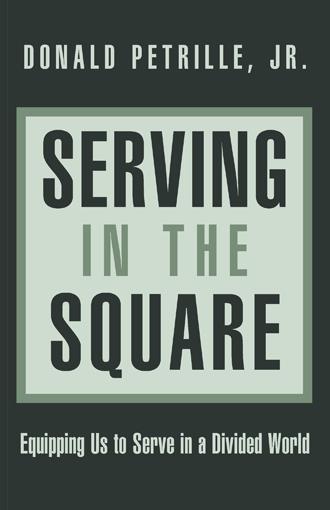
Serving in the Square
Equipping Us to Serve in a Divided World
by
Book Cover & Preview Text
While our ultimate citizenship is in heaven, while we are here on Earth, we have duties to our communities, nation and the world. We also have rights which God as our Creator embedded in simply because we are humans. These rights, such as the right to be free from physical harm, to live one’s life peaceably, to own things and to speak and worship peacefully are essential elements of the concept known as “Natural Law.” The medieval Christian philosopher St. Thomas Aquinas extensively discussed natural law in his Summa Theological. Aquinas concluded that just laws are those which further the common good and did not defy natural law. The “common good” is often defined as those things which humans are naturally inclined to do. They include: - preserving life, - having, raising and educating children, and - living in an ordered society that seeks to do the Lord’s will. These acts are all part of our natural human aspirations, but inhibited by our sinful inclinations. To inhibit our sinful inclinations, Aquinas found that natural law also places other important duties on citizens. We are obligated to know the Lord, to shun ignorance and to understand our own fundamental, fallible nature as we were created. Natural Law transcends time. It is not changeable. Like God, it is eternal, true and unchanging. Why? Because it comes from Him! No legislature, government or regent can suppress or change these concepts. They are buried deep in the human psyche. When a law or government violates natural law, we feel a deep sense of injustice. We can summarize natural law as, hating what is evil, clinging to what is good, being devoted to each other in love, and honoring one another above yourself. "Blessed is the one who does not walk in step with the wicked or stand in the way that sinners take or sit in the company of mockers, but whose delight is in the law of the Lord, and who meditates on his law day and night. That person is like a tree planted by streams of water, which yields its fruit in season and whose leaf does not wither— whatever they do prospers. (Psalms 1:1-3 [NIV])" In short, most people instinctively understand natural law. Christians often unconsciously model their relationships with other people by Natural Law. Most any person raised around Judeo-Christian traditions, even if they do not profess faith in God, expect their friends, neighbors, colleagues and acquaintances to act consistently with natural law. We understand natural law when we instinctively recoil at acts of violence, oppression, mutilation and slavery and are attracted to truth, beauty, freedom and creativity. Likewise, the vast majority of people innately approve when a law preserves human dignity, and disapprove when laws oppressive and unjust. They have a desire to care for others who lack sufficient resources. They understand that no governmental authority can change these natural inclinations in the human heart. These inclinations can be trampled and suppressed by power, violence, fear and greed, but their flame is never extinguished. “Let those who love the Lord hate evil, for he guards the lives of his faithful ones and delivers them from the hand of the wicked.” (Psalms 97:10 [NIV]). Societies do not need complicated bureaucracies, police forces and volumes upon volumes of written statutes to abide by Natural Law. It is written upon the human heart as universal truth, and we can understand it in our worship and in our ministry. Citizenship is easy when our government’s laws align with natural law. Submission to Authority and Its Limits History records that governments do not always create and enforce their laws according to natural law, and certainly not according to biblical tenants. The Apostle Paul spoke clearly of our duties as citizens when writing to the Church in Rome: Let every person be subject to the governing authorities. For there is no authority except from God, and those that exist have been instituted by God. Therefore whoever resists the authorities resists what God has appointed, and those who resist will incur judgment. For rulers are not a terror to good conduct, but to bad. Would you have no fear of the one who is in authority? Then do what is good, and you will receive his approval, for he is God's servant for your good. But if you do wrong, be afraid, for he does not bear the sword in vain. For he is the servant of God, an avenger who carries out God's wrath on the wrongdoer. Therefore one must be in subjection, not only to avoid God's wrath but also for the sake of conscience. For because of this you also pay taxes, for the authorities are ministers of God, attending to this very thing. 7Pay to all what is owed to them: taxes to whom taxes are owed, revenue to whom revenue is owed, respect to whom respect is owed, honor to whom honor is owed. (Romans 13:1-7 [NIV]). Paul emphasizes the point when he writes Titus, and states, “Remind the people to be subject to rulers and authorities, to be obedient, to be ready to do whatever is good, to slander no one, to be peaceable and considerate, and always to be gentle toward everyone.” (Titus 3:1-2 [NIV]).
Formats

Book Details
About the Book
Serving in the Square explores leadership, history, civics and faith from a Biblical perspective. The material investigates Biblical models of leadership, the criteria and qualifications Christians should seek in their leaders, and how Biblical leaders like Daniel, Joseph and Nehemiah applied these concepts serving pagan kingdoms. The material turns to how Christians influenced the formation of the American colonies, adopting the Declaration of Independence and implementing the American Constitution. Readers will understand how religious tolerance and the Great Awakening caused Americans to rethink God’s plan for government. Ultimately, the course concludes with a discussion of some of today’s issues from a Biblical perspective and encourages Christians to dedicate their energies to influence the public square. Serving in the Square, read alone, or as a part of an 8 week small group class will encourage readers to stand for truth, be more engaged citizens and better leaders.
About the Author
For nearly three decades, Don Petrille has stood at the intersection of faith, law and politics. As a practicing lawyer, community leader and an elected official in one of Pennsylvania's largest counties, he has watched our politics become more divisive as faith is driven from the public square. During two terms in public office, Don managed a $3 million budget, expanded services and led the state professional organizations. He decreased costs and expanded services, increasing productivity over 30%. In 2013, he stood his ground as Pennsylvania’s lead defendant in the ACLU’s same-sex marriage lawsuit. In his legal practice, Don focuses on small business, real estate, litigation and estate planning. He is a qualified mediator, resolving disputes outside of court. In the community, Don has coached high school mock trial, his daughter’s softball teams and student leadership. He has also helped his church organize worship and prayer for a national revival.