
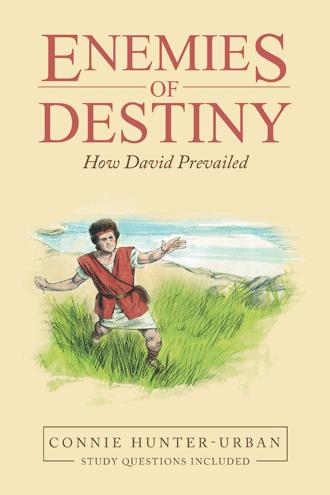
ENEMIES of DESTINY
How David Prevailed
by
Book Cover & Preview Text
THE ENEMY’S REACTION
Despite Israel’s concern, this boy proceeded confidently with his trivial arsenal. His approaching Goliath must’ve created an amusing sight to the giant and massive Philistine army. Guffaws probably erupted in their ranks, but David wasn’t deterred. Armed with scant weapons, he drew closer. Simultaneously, Goliath and his shield bearer edged nearer to David. The giant belittled his age and appearance, then acted insulted by the Hebrews’ inferior representative. He asked if he were a dog, and David was coming with sticks. His booming voice cursed David by his pagan gods and bade him to draw closer so he could feed him to birds and beasts. However, even thunderous threats from that enormous man didn’t shake David’s confidence in his God (see 1 Sam. 17:41-44). He understood what Paul would later say: “God…gives life to the dead and calls those things which do not exist as though they did” (Rom. 4:17). In the natural, he was all-but-dead-and-defeated by this superior creature’s hand. However, David was calling things in the Spirit realm into being. He proclaimed triumph; so in God’s economy, victory was pronounced into existence. A large chapter in David’s destiny story was ready to unfold.
BEWARE: Of your reaction to one who threatens or ridicules you.
David told Goliath that though he approached with sword, spear, and javelin, David had a greater weapon—the name of his God, whom the giant had defied. God would give David victory and Goliath’s head. Israel would defeat the Philistines and give their carcasses to the birds and beasts (see 1 Sam. 17:45-46). Then, they would know the “Lord does not save with sword and spear; for the battle is the Lord’s, and He will give [them] into [Israel’s] hand” (1 Sam. 17:47). Too often we undertake the battle ourselves when the Lord wants it. Speaking triumph in faith then following God’s leading produces His outcome. God would receive glory for this amazing, impossible victory through David’s hand because with God, impossibilities become realities (see Matt. 19:26).
BEWARE: Of thinking the battle is yours, not God’s.
THE VICTORY
As the giant arose and marched haughtily toward David, the shepherd hastened toward him. Goliath’s huge sandals probably raised a swirl of dust as they crunched loudly on the hard ground while he descended to meet his foe. Their booming echo across the mountains likely made the Hebrews, silently watching, even more fearful as he raced down the mountain toward the valley and his mismatched opponent. What a difference between David and other Israelites! Though Eliab and Saul had doubted David’s ability, neither they nor any other Hebrew had stepped forward. Instead of running to Goliath, they’d run from him. To achieve victory, a battle must occur. If we flee because an intimidating enemy advances, we can’t succeed. In the Lord’s name, we run forward in confidence that God will defeat the enemy and use this experience for our promotion. As the opponents approached each other, David reached into his bag and removed one stone (see 1 Sam. 17:48-49). To thrust it, he would’ve placed the rock into the leather’s hollow part that held the cords together. Then, he could gain speed by encircling his head with extended straps. When they were spinning fast enough, he’d let go of one cord so the stone would propel toward Goliath. To be accurate in hitting his target, he would’ve practiced many hours.7 That time had occurred while testing his weapons on the hillsides.
BEWARE: Of warriors who run away from instead of toward the battle.
David had collected five stones, but he needed just one. The Lord always gives more than we require. He hurled the slingshot, let the rock soar, and hit Goliath on his forehead. His accuracy was spot on. The stone sank deeply into the giant’s head, and he fell on his face onto the ground. With one meager weapon he’d tucked inside his shepherd’s bag, he dropped and killed the mighty man. He ran and stood over him (see 1 Sam. 17:49-51). How dynamics had changed from moments earlier when the giant loomed above him! God doesn’t see from our vantage point. Observing from His perspective changes things, often in a moment. Oh, what a difference God can make in that instant when we act in faith!
BEWARE: Of looking from your viewpoint rather than from God’s.
David had no sword to finish his victory. He saw Goliath’s, so he slid it from its sheath and, ironically, cut off the giant’s head with his own sword. Disbelieving silence probably permeated both armies as they processed the impossibility of what had just happened. Then, when reality of their champion’s death dawned on them, the Philistines didn’t submit to Israel as rules of warfare dictated. Instead, they fled. They’d entered that battle with greater weapons, but with an enormous disadvantage. The Philistines had trusted in their hero while David trusted in his God. Men of Judah and Israel rose, shouted, and pursued. Wounded Philistines littered the roads, which proved David’s prophetic word about birds eating their carcasses. After Israel’s army returned, they plundered the Philistine’s tents. David took the ultimate prize, Goliath’s head, to Jerusalem, but he put the armor into his tent (see 1 Sam. 17:51-54). Because David’s character was to credit God with victory, not his efforts, the word tent here probably refers to God’s tabernacle.8 That’s consistent with Goliath’s sword later being with priests in Nob (see 1 Sam. 21:9).
BEWARE: Of thinking your enemy will act with honor after his/her defeat.
Formats

Book Details
About the Book
Have you been called for God’s purpose? When that happens, you should be aware that something else will occur—attacks. The enemy doesn’t want you to move into your destiny, so he uses any obstacle to keep you from continuing toward the goal. Even people. David’s life demonstrates those dynamics. However, he didn’t let his massive number of attacks deter him but continued to maneuver toward his grand destiny despite the assaults. By studying his examples, we can learn how to recognize that someone is being used by satan as our enemy and how we can emerge victorious and stronger despite the attack. As we move toward our God-ordained destiny, God will use even hard times for our good.
About the Author
Connie Hunter-Urban grew up in Oxford, Ohio. She earned a B.S. in English and an M.A. in secondary education from Miami University and taught high school English for 33 years before retiring in 2009. Connie and her husband Wade now live in Connersville, Indiana, where they co-founded Restoration Ministries. During their time in the ministry, Connie and Wade have pastored, evangelized, and taught. She and Wade blog online, conduct workshops, host services where others may use their gifts of Holy Spirit, stream a weekly teaching series, and write and publish a free semi-monthly ministry newsletter. Now, she writes and speaks at conferences and churches where she ministers with words of knowledge and prophecy and witnesses many miracles. Connie has several published books: God’s Plan for Our Success, Nehemiah’s Way; The Elijah Anointing; Your Holy Spirit Arsenal, which she co-authored with her husband; and Be Healed! Connie also has a children’s book series, The Josie Adventures.
Contact info:
Wade and Connie Hunter-Urban
P. O. Box 634
Connersville, IN 47331
Phone: 765-825-2030
conniehunterurban@gmail.com
facebook.com/connie.hunterurban
twitter.com/Restor_Ministry