
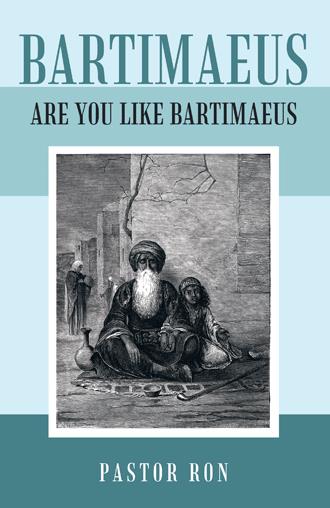
BARTIMAEUS
ARE YOU LIKE BARTIMAEUS
by
Book Cover & Preview Text
Introduction
In the Gospel of Mark, we find a certain blind man named Bartimaeus. He is mentioned only once in scripture, and no other gospel writer identifies this man and his father but Mark. We find blind men that Jesus healed in all the gospels, but only here do we find a blind man named Bartimaeus. The Gospel of Mark, being the first of the four gospels written, focuses on how Jesus ministers to the physical and spiritual needs of others. If you have viewed the television show Downton Abbey, you have some sense of a servant’s role and their position in life. The Gospel of Mark presents Jesus as a servant.
As I take note of Mark’s gospel, I notice that Mark does not take the time to mention many people’s names. This action-packed, fast-moving gospel might be compared to an action movie. Mark uses the word “and” more than a thousand times in this gospel, and Jesus is presented as moving quickly from one scene to the next in a chain of event after event linked by words such as immediately, straightaway, behold, and departed.
The Gospel of Matthew presents Jesus as the King, the teacher, and “lion-like.” Every king has a lineage, and we find in the gospel of Matthew the lineage of Jesus from Abraham to Joseph, Jesus’s earthly father. The Gospel of Luke presents Jesus as the perfect man, man-like, and every man has a birth record, as does the Son of Man, as Luke records Jesus’s birth records back to Adam. The Gospel of John presents Jesus as the mighty God, eagle-like, but with God there is neither beginning nor end—He is from everlasting to everlasting. John 1:1–2 says, “In the beginning was the Word, and the Word was with God, and the Word was God. He was in the beginning with God” (NKJV).
But here in the Gospel of Mark, we are given a view of Jesus as a servant. He is presented as being ox-like, and Mark lists the miracles He performed. Jesus’s birth is not mentioned, the shepherds are not present, and there is no visit from the wise men from the east. But Mark begins with John baptizing Jesus, and the ministry of Jesus begins. How fitting this is, because a lowly servant has no introduction nor do those whom he is serving want to know about him, his family lineage, or his past. They only want to be served by a servant. The Gospel of Mark highlights Jesus’s work as a servant.
Matthew 20:29–34 speaks of two blind men being healed as Jesus comes out of Jericho. Luke 18:35–43 speaks of a blind man calling out to Jesus near Jericho, but because Mark is the first gospel written and Matthew and Luke may have gotten their information from Mark’s gospel, I have chosen to stay basically with Mark’s version, which focuses on Jesus’s role as a servant looking toward the cross, serving man and representing man even in His death. It would seem as if Mark’s mission of writing was to show Jesus’s life as a servant to man and His death for man on the cross. This is also illustrated in Mark 15:39: “So when the centurion, who stood opposite Him saw that He cried out like this and breathed His last, he said, ‘Truly this Man was the Son of God!’” (NKJV).
In the midst of this action-packed drama, Mark mentions the man Bartimaeus. As I stated earlier, Mark does not take time to mention the names of many of the people Jesus encounters because of how fast this gospel moves. Jesus goes from one setting to another, one scene to another, one backdrop to another backdrop. This perked my interest, and questions arose in my mind. Who is this Bartimaeus? Why is he mentioned only here, and no one else mentions his name? Why is his father’s name mentioned? We know he follows Jesus toward Jerusalem, but where does he go after this? Why did those around him try to stop him? And there are many other questions that I try to address in the following pages. Over the years more insight has been given to me about Bartimaeus which has allowed me to put these revelations together in this book. It is amazing how the Holy Spirit can give new reflections on the same scriptures and from a different angle. Also, some of this perceptiveness comes from spiritual growth and study.
I have concluded that in these few scriptures of the tenth chapter of Mark, we can find the complete role of the church and the members of the church and our work in society beyond the church walls.
Formats

Book Details
About the Book
In the Gospel of Mark, we find a blind man named Bartimaeus.
Bartimaeus was blind, but he could hear, and it was his hearing that enabled him to “see” Jesus. We can learn a lot from him as we, too, must find the strength to see God amid the storms of life.
In this book, Pastor Ron takes a deep dive into the lessons Bartimaeus provides today. He emphasizes that even if no one else sees Jesus, you must be able to act on faith. After all, faith is taking a blind step when you can’t see where you are stepping.
Bartimaeus was willing to take a step of faith because he saw something that no one else could see. He knew that Jesus could heal him—and it is only when we see Jesus that we have the power to bring out our gifts and talents.
God designed you for a purpose, and Jesus empowers you to fulfill it, but you must see Him just as Bartimaeus “saw” Him. No matter how dark life may seem, you can overcome anything when you know Jesus is nearby.
About the Author
Ron Whitlock Sr. is the pastor of New Beginnings Christian Ministries in Bowling Green, Kentucky. He graduated from Western Kentucky University with a Bachelor of Arts in religious studies and history and attended Newburg Theological Seminary.