
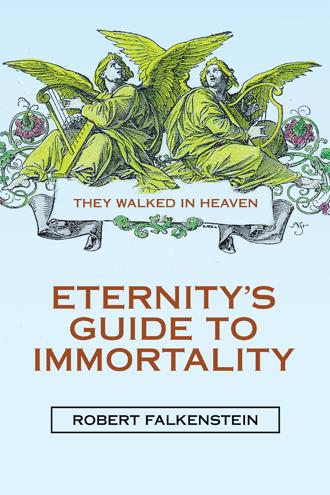
Eternity’s Guide to Immortality
They walked in Heaven
by
Book Cover & Preview Text
Chapter 1
If They Only Knew
From here, our vision of heaven is clouded by distance. Ignorance often takes the place of knowledge, leading to many fables and false ideas, on which much effort and money has been spent. Many great civilizations have come and gone under these spells. The Tower of Babel, where Nimrod thought to build to heaven, brought instead the twin judgments of confusion and destruction.
So the Lord scattered them abroad from thence upon the face of all the earth: and they left off to build the city. (Genesis 11:8)
Other nations of antiquity saw themselves as the eyes of the world, and they created elaborate rituals connected with extraordinary sacrifices. Yet for all their efforts, they knew little more than that heaven was a desirable place because they were limited by the earthly dimensions of their minds.
The most documented accounts are by the pharaohs of Egypt, whose edifices continue to create wonder and amazement as modern-day people look upon the pyramids and temples they built at the height of their power, four thousand years ago.
Their works demonstrate that they clearly believed there was life after death and that heaven was a real place. The pharaohs were prepared to do whatever it took to ensure they would have a place prepared for them in eternity. In their zeal, they left no stone unturned and considered no price too high for immortality in heaven.
Napoleon testified to this when he occupied Egypt. He estimated that the stones used to build the three pyramids of Gaza could have made a stone wall, nine feet high, that surrounded all the borders of France.
The pharaohs and their people were focused on eternity, and they understood that eternity was more than just a long time with a beginning and an end. The concept that eternity has no borders boggles the mind, yet God wants us to understand and reach beyond ourselves to Him with secrets that He desires us to know today.
The Egyptian Book of the Dead, with its many spells and incantations, covers every contingency in dealing with the forty-two gods who would bar the way to heaven. It is clear that, collectively, they believed they were unworthy, but to ensure that they would be accepted, this astonishing collection was created. The term the Book of the Dead originally was coined by tomb robbers, who first called it the Dead Man’s Book.
The skill and imagination of its writers is evident—along with their foolishness and folly. The blind were leading the blind, and all were falling into the same ditch of ignorance and despair. The writers were partially motivated by money and power, along with what they considered logical, thoughtful issues and a good bit of desperate guessing. In the end, their many priests wrote about something they neither knew nor understood but with the consolation that they had tried their best.
This collection of magical spells, incantations, prayers, and songs, however, was not for the workers who built the pyramids but for those who could afford it. These people saw that their only hope was to be buried in the shadow of these great tombs. Archeological records bear this out by the number of single incantations that the man on the street could afford. This played right to heart of individuals, as it does today, revealing the common concern and inward need of our souls.
Throughout the ages and among all nations, the persuasion of a future life has prevailed, even as mighty kingdoms rose and fell, and the sands of time concealed their presence from the generations to come. This was not from the refinements of science or the speculations of the philosophy but from a deeper and stronger source—the natural sentiments of the human heart.
No part of humanity is excluded—rich or poor, learned or unlearned, peaceful or violent; these concerns are common among them all. Even the belief in God is not more general on the earth than the belief in immortality. People entertained dark and confused notions regarding a future state. Yet in this state, they looked for retribution, both for the good and the bad and in the perfection of pleasures, as they knew best—and valued most highly—the rewards of the virtuous.
Here we begin to see the beginning of God’s future plan, from the least and going forth to the greatest. The virtuous were supported by this hope, and the guilty were tormented with dread of what would take place after death. As death approached, this hope of the former and fears of the latter redoubled as the souls began to discern their future abodes. All the operations of conscience moved upon this belief of immortality, which the Egyptians so readily demonstrated and desperately tried to control.
The Egyptians’ fear of judgment and punishment affected all levels of their society. As a result, their religious leaders, four thousand to five thousand years ago, devised spells to deceive their gods and used magic to control them through knowledge of each deity’s name. Add to this the many enchantments they designed to protect and silence the petitioner’s heart, lest it speak out before them, condemning the individual to hell forever.
Formats

Book Details
About the Book
In a moment of time, author Robert Falkenstein transcended both the mind and the understanding of humans to see the greatest victory celebration of the ages—that of heaven, where time merges into eternity and children from all tongues, races, and nations who once walked the earth are joined together as one to usher in a new age, in which neither pain nor death will have a place. Building on this experience, Eternity’s Guide to Immortality seeks to fill your heart with joy and wonder as you journey through heaven’s golden streets. Come see the endless sights and sounds of heaven through the eyes and words of countless generations who enjoyed its deep and endless joys. It is truly a world beyond comprehension, where God has made provision for all. Learn about God’s plan for you, and discover why He wants you to live with Him forever, where time ends and eternity begins, where the endless pains and worries of this world cannot enter. There, you will never be alone. This personal narrative and testimony invites you to explore what heaven has in store for you so that you may embrace God’s plan for you.
About the Author
Robert Falkenstein a minister and dedicated Bible scholar who serves God’s people and works to reveal God’s hidden mysteries for today. Ordained in 1975, he has founded several outreaches and was the pastor of the Full Gospel Church for forty-one years. He is the current director of the Full Gospel Defenders Conference of America and has served as a professional correctional chaplain and director of chaplaincy services for thirty-seven years.