
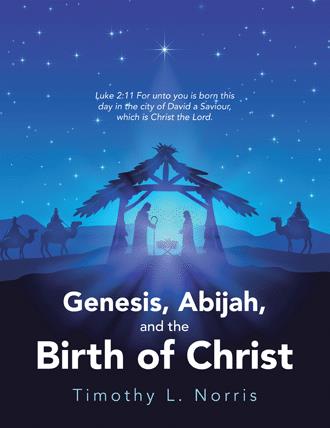
Genesis, Abijah, and the Birth of Christ
by
Book Cover & Preview Text
Introduction
For years, researchers have attempted to place the life of Jesus of Nazareth in its proper historical and chronological context. Early Christian historians and chronologists believed that Christ was born around 3 to 2 BC. Later historians and theologians, based primarily on the writings of Flavius Josephus, sought to place his birthdate slightly earlier, around 6 to 5 BC.
This has been the prevailing opinion for quite some time. More recently however, a new set of investigations have once again led to a reappraisal of a 3 to 2 BC birthdate as a real possibility. These recent investigations include those of W. E. Filmer’s “The Chronology of the Reign of Herod the Great” questioning the widely accepted 4 BC eclipse as the one prior to Herod’s death, Ernest L. Martin’s biblical and celestial observations in “The Star that Astonished the World,” and Roger T. Beckwith’s theory regarding the courses of the Jewish Priests in “St Luke, the Date of Christmas, and the Priestly Courses at Qumran.”
These efforts were acknowledged by renowned biblical scholar Jack Finegan in his work “The Handbook of Biblical Chronology.” This new information caused him to abandon his original support for a birthdate no later than the year 4 BC in an earlier edition of his book, in favor of a 3 to 2 BC dating for the birth of Christ in his more recent edition.
More recently, Rick Larson produced a DVD called “The Star of Bethlehem” that further strengthened the case for placing the birth of Christ in the 3 to 2 BC timeframe. Specifically, the DVD identifies the 17 June 2 BC conjunction of Jupiter and Venus as the birthdate of Jesus of Nazareth.
The effort undertaken here develops a theory that supports the 17 June 2 BC birthdate by incorporating additional details regarding the course of Abijah, the date of Jesus’ conception, and some interesting and related celestial and biblical observations. We will develop the narrative of Abijah based on Beckwith’s theory, and incorporate Martin’s and Larson’s findings into a unified theory for the birthday of our Lord Jesus Christ.
However, determining our Saviour’s birthday addresses only one part of a much larger set of issues. To be viable, a complete theory must develop a counterargument for the death of King Herod that most historians believe followed soon after the eclipse of 13 March 4 BC. There are several additional issues that must be accounted for as well before a 3/2 BC birthdate can be accepted by the larger community. These include reconciling both the biblical and historical accounts regarding the reign of Herod’s sons, the course of Abijah, the census of Quirinius, the timing of the visit of the Magi, the War of Varus, coin evidence, the timing and duration of Jesus’ ministry and crucifixion, etc.
It is our intention in the following pages to use a combination of secular history, archaeology, astronomy and Holy Scripture to develop a comprehensive theory, piece by piece, that supports the chronology for the birth of Jesus of Nazareth on 17 June 2 BC while addressing this larger set of issues as it must. Once our task is completed, the results will be summarized and left for the reader to decide if we have accomplished our goals. For our goal is nothing less than untangling and settling the long‐standing issues in determining a chronology that is consistent with both secular history and Holy Scripture, and accurately dating the birth, ministry, and crucifixion of Jesus of Nazareth and securing His proper place in history.
Formats

Book Details
About the Book
The birth of Jesus Christ is the cornerstone of human history. Our years are numbered in accordance with the eras BC and AD signifying Before Christ and Anno Domini, i.e., “in the year of the Lord.” We celebrate the biggest holiday of the year in remembrance of His birth but amazingly, we still do not know the actual day He was born. For over two thousand years now, the date has remained shrouded in mystery.
However, God may have provided for us just enough information to untangle this longstanding riddle. Sifting through that information will be the focus of this book. Using a combination of secular history, archaeology, astronomy, and Holy Scripture, we will develop a comprehensive theory, piece by piece, that supports the chronology for the birth, ministry, and crucifixion of Jesus of Nazareth. The evidence will be built on a firm foundation starting with God’s declaration in Genesis 1:14 that among other things, the heavens are for signs. The famous star that “stood over where the child was,” or the “Star of Bethlehem” is one of those signs.
Step by step, we will sort through the evidence to build our case one layer at a time, comparing our theory and chronology with secular history, supporting our belief that God’s only Son truly walked among us, and that the Bible has provided for us an actual historically accurate account of the life of Jesus of Nazareth.
About the Author
NA