
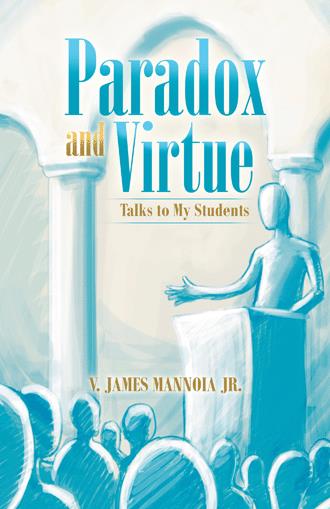
Paradox and Virtue
Talks to My Students
by
Book Cover & Preview Text
Not Seeing…
Over the past several weeks, I have spent a lot of time driving in blizzards, night and day, on ice and snow, headed east and headed west. The most recent stretch of course was the long pull from New York to Greenville in a two-car caravan lugging those parts of the family that would not have found the inside of the moving van hospitable to living creatures: people, plants, and even our black lab Fiel. And of course it happened smack in the middle of the snow storm of the decade! But there had been an earlier trip too. Our family gathered for the holidays at my son’s bachelor condominium in downtown Minneapolis. New York to Minneapolis in the winter is a long seventeen hours! How many healthy rice cakes can you eat before the craving for real junk food wins out?! The trip back home to New York was even longer. Naturally, the after Christmas catch-up meant truck traffic was timed to match our travel. Every tractor trailer in America was on I-90 headed east that dark snowy night. It seemed my wipers had been shipped from England on the Mayflower, and when I replaced them, the new ones immediately froze up. What’s more, the heavy wind caught them enough on every sweep to lift them off the window leaving an opaque band of dried salt precisely at eye level. To make matters worse, it reached that critical moment of blindness puncturing the truck’s bow wave of muddy spray, the left lane would get icy and the washer fluid reservoir would dribble and plug up!
To put this all another way, over the past several weeks changing homes and changing jobs has forced me to spend a lot of time thinking about vision—wishing I could see more clearly. Maybe you have felt the same way these days. Whether you have braved the wintry interstates or debated what major you would like to choose, or even just worried what you will do when you graduate in May, you may also have been thinking about vision.
My training is in physics and in philosophy. In physics I specialized in optics, which means I spent a lot of time huddled in a very dark lab thinking a lot about light. As a philosopher, I specialized in metaphysics, which means I spent a lot of time wrestling in the dark with a lot of definitions, wishing I had some light! Naturally, both these experiences affect my thinking and what I would like to say about vision. And one inclines me to the practical, the other to the theoretical!
That word vision reveals an interesting ambiguity. Often it refers to the result of seeing. It is a kind of mental picture; as in “I saw a vision,” or “Heather is a vision.” At other times it refers to the capacity to see, as in “I had the optometrist check my vision,” or “Owls have amazing night vision.” And sometimes this ambiguity can get confusing. On the highway that night a few weeks ago I had my vision but sure wished I had a vision. I could see but sure wished I could see. I think you get the picture here, right?
So maybe, like me, you sometimes get confused and wonder if you have vision at all. You believe you can see but you can’t really see. It may be that you do have the capacity to see, but you just can’t see the picture. I would like to suggest two reasons why this sometimes happens, why it is okay, and what we can do about it.
It’s too DARK…
Sometimes, those with good vision cannot see because it is too dark.
That night returning from Minneapolis to New York, we had been driving thirteen hours already. Chicago was history and Cleveland was ahead. Moisture laden air over warm Lake Erie was driving prevailing northwesterly winds back over cold northern Ohio. The temperature dropped through the dewpoint like an express elevator and with it dropped tons of lake effect snow. It was very dark. At first, we moved ahead; not at all sure where we were going. I used all the tricks. Living in western New York—“lake effect heaven”—you learn them well. They are survival skills! And they are all good advice for people with vision who cannot see. First, you don’t change directions too quickly. Second, you slow down. Third, you look out the windows to the sides to gauge the road. And fourth, at least if you’re a former physicist, you may even try to imagine how the tires are “feeling.” But above all, fifth, you keep moving. Sometimes it takes great courage to keep moving. Whether it is passing a tractor trailer in a blizzard at night or just getting up on those dark mornings when your vision is faded, it takes courage to keep moving because you wonder if you really can still see.
By about 9 p.m., we realized we were alone on the road. At the next rest area, we pulled in and discovered where everyone had gone. The whole of I-90 was already there! We talked to others, we listened, and we weighed our options. Again, each of these is good advice for people with vision who cannot see. But in the end, we did not move ahead; we waited. We stayed a while at the rest stop, then crawled ahead slowly a mile or two to an exit without knowing for sure where we were going. We found a motel and waited again—this time, reluctantly, overnight. We still had a clear vision of our home in Houghton 250 miles ahead. But for the time being, because we could not see, we needed to wait. As we waited, we hoped we would see more clearly tomorrow. And we did. The day was clear, and we moved forward again, all the way home. So sometimes, when we have vision but cannot see, it takes courage to move ahead. But sometimes, it takes a different kind of courage to wait; not sure of where we are going.
Formats

Book Details
About the Book
Most of us work hard to resolve the never ending “either/or” dilemmas of our lives. But what if a central lesson for all people was to learn instead to embrace many of these paradoxes? In this book, a university president speaks to his students using everyday events from the campus and his personal life urging them to pursue the deep moral virtues that comprise our character; patience, trust, hope, grace, vision and more. To do this he tells them to consider many points of view, choose passionately, but continue openly humble. As a lifetime follower of Jesus, the author exhorts his students and his readers to remember that now we see through a glass darkly, but one day face to face.
About the Author
Rev. Dr. Jim Mannoia is well known to the thousands of students passing through Greenville University in the first decade of this century. As president, his regular chapel and convocation talks, combined current and campus events with the challenging events of his personal life woven into his passionate philosophy of Christian liberating arts education. The talks were about life, and bridged many worlds. He was a “missionary kid” in Brazil, trained in laser physics at M.I.T., drove taxis in Boston, worked with drug addicts in Hillbrow, South Africa, shifted to metaphysics for a Ph.D., taught physics in Pennsylvania, then philosophy for 15 years at Westmont College. For two years he was professor at the University of Zimbabwe. Finally, as he puts it, he “went over to the dark side,” becoming first the Academic Vice-President at Houghton College and eventually President at Greenville. After retirement, he consulted around the world including in Iraq, South Africa, and for the government of Rwanda. He lives in Santa Barbara, California.