
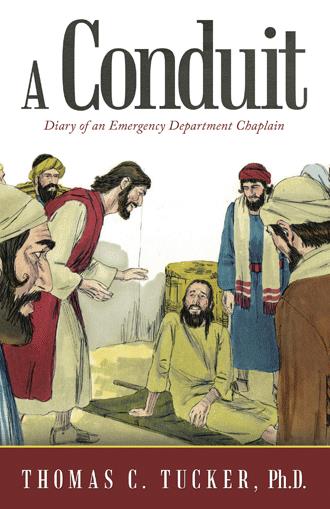
A Conduit
Diary of an Emergency Department Chaplain
by
Book Cover & Preview Text
Cases 1.1: The Call
“ACTIVE SHOOTER” scrolled across my large-screen TV early one morning. An aerial view from a helicopter showed a local high school surrounded by police cars. The reporter’s voice said, “Ambulances have been seen leaving the scene.” I dropped everything, grabbed my hospital jacket and credentials, jumped in the car, and headed toward the hospital, only fifteen minutes away. My hospital with its emergency department and trauma units was the nearest to the school, so I knew those ambulances were headed our way.
My phone rang as I approached the entrance to the hospital. The ED coordinator said, “Dr. Tom, can you come now? We need you.”
I answered, “I’m already on my way. I’ll be there shortly.”
As I entered the hospital, a nurse recognized me and said, “We’re setting up the large conference room for family and friends.” It was on my way to the ED, so I stopped in.
An ED tech who was also an EMT was setting up an information table. She told everyone she was in contact with the hospital’s ED and other hospitals, so she could obtain information for those trying to locate a student or teacher at the high school if they were receiving medical care.
While we had the room’s attention, I prayed for the forty or so who had already assembled. I headed toward the back door of the conference room, and on the way, I stopped and prayed with a table of students who were trembling. Then I ducked out the back door into a hall that led straight to the ED.
Four trauma surgeons, their scrub nurses, and support technicians were standing by, gowned and gloved. All noncritical ED patients had been moved to other areas of the hospital. All three of the ED trauma suites were open and ready. All noncritical surgeries had been rescheduled, and the OR suites were standing by.
EMTs called in their triage assessment of the patient they were transporting by ambulance. Highest-need patients were rolled immediately into one of the ED trauma suites for stabilization before going to the OR. Others were placed in nearby ED rooms for further assessment and stabilization. Only parents were allowed in the ER; all others were sent to the large conference room.
Eight injured students came to our ED. Two of our patients went to OR as quickly as possible. I prayed with their parents and sent them to the surgery waiting room. Two other patients had what were judged minor wounds, with bleeding controlled by bandages applied by EMTs. I was able to visit with these and their parents while the staff treated the others. When we were notified the shooter was in custody and there were no additional injured victims, the trauma surgeons who had not gone to the OR began treating wounds in the ED.
I took a break and went back to the conference room, where the crowd had tripled. The pastor from a large local church came and asked to see me. He was volunteering to work with the increasing number of family and friends who were now overflowing the large conference room. I welcomed his help, and he further volunteered to call his youth minister to work with the large number of students. I prayed with another table of students and a couple tables of family and friends and then headed back to the ED.
On the way back, a pastor friend from another denomination called me. He guessed I was in the middle of this crisis and called to pray for me. When I got back to the ED, I was able to visit with the rest of the injured students and their parents.
There was humor amid tragedy. One student was shot through the buttocks. He was lying on his stomach. He rose up on his elbows and said with a big smile, “The bullet ended up in my hip pocket.”
I took a quick, light lunch break. When I returned, all the wounded students had been admitted to the hospital for observation or released to the care of their personal physician. I resumed my normal ER rounds as the patients who had been moved out temporarily were returned to the unit.
As I finished, a Catholic priest caught me in the hall. He had finished his daily calls in another hospital a few miles away. He knew I was in the ED during the crisis and came to care for me. We went to the large conference room, which was beginning to clear. We got snacks from those the hospital had provided for the large number of visitors and sat down to talk. The priest debriefed me and prayed for me.
I soaked my feet when I got home late that afternoon. As I leaned back, another pastor friend called. He knew I had been on the front line and called to pray for me. I sat back and thanked God for sending five pastors from four different denominations to support me. This is truly an ecumenical ministry.
A month later, I was recalling some of these events with a few friends. It was remarkable the number of people who came to the hospital. Two of the injured students were members of the high school baseball team, and the entire team came to the hospital. I mentioned how pleased I was that the traumatized students would let an old man talk with them, and how rewarding it was to see their faces relax from the tenseness of frozen fear. One of these friends remarked, “They needed a grandfather figure to validate their feelings and give them permission to express those feelings.”
God had placed me in the right place at the right time.
Formats

Book Details
About the Book
“Dr. Tom, can you come now?” As a chaplain in the emergency department, author Thomas C. Tucker would respond regardless of the hour, giving all cases the same care and attention. Every patient and family member in the emergency department would be in some state of trauma, or else they would not be there.
A Conduit: Diary of an Emergency Department Chaplain recounts Tucker’s personal experiences as a hospital chaplain. He divides his recollections into landmark cases, which defined his service; teamwork cases, which showed his integration with the hospital staff; final services cases, for families at the end of life for a dear one; ecumenical cases, serving those in need without discrimination; and care and comfort cases, combining compassion with spiritual care. The stories he shares demonstrate compassion, action, and faith in practice.
Offering a firsthand view of a hospital emergency department, this personal narrative reveals the role and experiences of a chaplain as a true member of the medical team.
About the Author
Thomas C. Tucker, Ph.D., serves as a volunteer chaplain in a large regional hospital, providing both spiritual and comfort care to patients and their families, as well as support and assistance to the medical team. He has distributed over a gross of NIV large print Bibles to patients and offered prayer and comfort to over eighty-five hundred patients.