
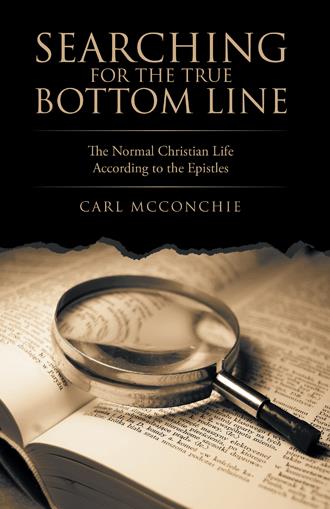
SEARCHING FOR THE TRUE BOTTOM LINE
The Normal Christian Life According to the Epistles
by
Book Cover & Preview Text
In his early thirties, with a wife and two kids, he was repairing the tail light on the back of a dump truck. Somehow, someone in the cab hit the starter pedal and because it had been parked in reverse gear, the huge vehicle lurched backward and in doing so crushed the repairman against a wall killing him instantly.
It was a devastating tragedy for the family, of course, but it was also something that deeply affected everyone in the small church family. A day or two after the incident a young man came into the church office. It took a few minutes for the pastor to understand what he wanted me, that pastor to do. Finally, after some delay the young man came to the point. He wanted me to lead a group of people down to the funeral home. There, we would stand around the coffin and ask God to bring back to life the one who had so tragically taken from us.
The question to be considered is, why not? If Jesus raised the dead, if Peter and Paul did it, as recorded in the book of Acts, why shouldn’t we? Is it not suggested by some that we follow Jesus’ example? As far as we know Paul had not actually seen Jesus perform such a miracle. But he did not hesitate, nevertheless, to attempt the impossible. Why shouldn’t we not hesitate to do such a thing? So, the chapter of this book is entitled, “WHY NOT?” (Taken from first few lines of chapter one, “Why Not”)(From chapter three- Case in Point)
Once in a dinner meeting with a small group of pastors, I took part in a discussion concerning the matter of exorcism. Our guest was a man whose special ministry was exorcism. He had written books on the subject. I took the opportunity to ask him about the fact that exorcism is not listed among the Spiritual Gifts found in I Cor. 21-14 or Romans 12. After hesitating a moment, he suggested that it is not singled out as one of the Charismata because all believers have the authority to do it when necessary. He did not address the fact that nowhere in the Epistles are all believers said to have such authority, nor are they encouraged to practice exorcism.
The above is a prime example of that which pertains to my thesis. Very often emphasis is given to matters that are not supported by the New Testament Epistles. There is no mention of exorcism in the Epistles, although, admittedly, there is a good deal about spiritual warfare. (taken from the first part of chapter three, “Case in Point.”)
She was a rather attractive woman in her forties, a new Christian, who was fighting a serious battle with cancer. Our church family in New Jersey had fervently prayed for this beloved woman. After several surgeries she was losing her battle. One day a man came to me and said, Pastor, I believe that the reason that the Lord is not healing her is because we are not fasting. It should be a matter of fasting and prayer. In deference to his suggestion we did set aside a day of fasting and prayer. Nothing changed in her situation. And yes, it was a good experience for myself and others. That was many years ago. Now I have refined my thinking to realize that nowhere in the New Testament Epistles are we exhorted or admonished to practice fasting. It was good to just focus on the Lord, putting aside distractions and spending time in His presence.
This now brings me to state again that which is my thesis in this writing. Exhortations, admonitions and instruction for the Christian life today are found in the Epistles (the books of Romans through Revelation). The Epistles present to us the bottom line, that which is normative for our day. Fasting, as a spiritual disciple, is simply not there. (Taken from chapter four, To Fast or Not to Fast, the first part of the chapter)
Formats

Book Details
About the Book
People write books. They write books lifting up issues that they believe are vitally important for living a successful Christian life. The problem is: writers of the New Testament Epistles like Paul, Peter, James and John never mention these matters. How can something be so important to some modern-day writers and not even be mentioned in the Epistles? This is a book about exhortations, commandments and admonitions. It is a matter of what is actually exhorted in the Epistles and what is not. It is the writer’s hope that people will find freedom and peace with regard to the several matters exhaustively considered in these pages, matters such as exorcism of demons, fasting, and Sabbath keeping. Bottom line truth is to be found in the New Testament Epistles with regard to instruction for living the normal Christian life.
About the Author
After being ordained for the ministry at Grace Chapel in Lexington, Massachusetts, he began a pulpit ministry that extended over forty-six years, pastoring in two churches. He had received a degree from Gordon College, located in Wenham, Ma. majoring in philosophy. He then went on to receive his ThM degree at Dallas Theological Seminary, majoring in theology.
After the Iron Curtain came down, he made a number of trips to teach at a Bible College in Minsk, Belarus. He was able to make nine trips to that former Soviet city. He and his wife, Phyllis, now make their home in Tucson, Arizona where he still teaches a Bible class for men.