
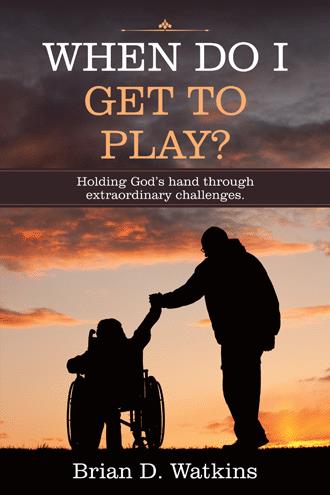
WHEN DO I GET TO PLAY?
Holding God’s hand through extraordinary challenges.
by
Book Cover & Preview Text
Introduction
"What I am doing, you do not understand now, but you will understand later." ~ John 13:7
Years ago, I remembered having a conversation with my mother about some ridiculous questions I would ask when I was a small boy. Questions she didn't have the answer to, items that didn't have an answer at all. I was only about four or five years old when my philosophical side began to emerge with these deeply profound questions of the universe. One of her favorites that I asked was, "Mom, how big would I have to be so I could eat our house?" Her answer, of course, "Don’t be silly, you can’t eat our house.” That answer just wasn’t good enough, so I responded with, “Yeah, but what if I could?” These types of questions are commonplace for kids, and it’s interesting to hear them and see their short-lived view of the world. It’s a mark of growth as we continue to ask questions throughout our lives, most with what we consider a little more world-based evidence.
Children filled with imagination lead towards questioning; as you get older, the questions come not so much from imagination but from the things you’ve learned throughout your life. Quick answers and even nonsensical answers to a child are good enough; there doesn’t have to be much evidence, just something that makes a bit of sense to them. Cows jumping over the moon are possible in the imagination of a child. Their original question may have been silly, and a likewise fantastic answer is usually all that is needed. As we grow older, those types of solutions stop working. We desire a much more concrete and relevant response to our thought-provoking question, something that can be proven, something factual. It leads us to look for our answers through human thinking. Solutions that may not be readily available, answers that may not have the concrete facts we desire. The critical point where a lot of us give up.
I think everyone at one point or another has reached the ultimate question, which is, “Why does God allow bad things to happen to good people?” We ask this question expecting an answer explainable through our human understanding. We’ve learned to expect a scientific or factual response. When no solution to this question is immediately available, or the answer to the problem is not what we want to hear, we begin to question our beliefs. Everyone experiences something terrible in their lifetime, or let me correct that, everyone shares what they perceive as something unpleasant. It’s easy to point the finger and blame others. It’s our human nature to find that scapegoat, that something that caused what we see as something wrong in our lives. Unpleasantness is evident on any given night, on any given news channel. We find it so easy to cast blame that we forget about what it will take to overcome the bad; it's too easy just to give up.
I wrote this book because I faced this question, and I gave up. I turned away from my beliefs and understanding of the existence of God. I spent years wrestling with my faith and understanding of why. In the end, though, I found my answers, and I found them because I finally gave in. I learned I needed God; I knew I needed a relationship with him. I realized that sometimes answers aren’t as straightforward as we expect them to be, sometimes it takes time to reveal why. I hope that anyone that reads my story may, in some part, see what faith in God’s plan can do for your life and the lives of others. It’s not always simple, but it’s worth the journey.
Formats

Book Details
About the Book
All new marriages face numerous obstacles and hardships. Imagine grieving the death of both of your spouse’s parents, adopting your five-year-old sister-in-law, and seeing your first child born with a disability, all within the first five years. This book is the story of how putting your faith in God can lead you through the unimaginable, finding joy in a unique journey creating dreams.
About the Author
Brian Watkins is married with three children in Lafayette, LA. They became guardians to his wife’s youngest sister after losing both of her parents at a young age. The couple’s first son was born with a disability known as Spina Bifida. Brian is a special education teacher and holds a MA in special education. He and his wife developed the Dreams Foundation of Acadiana to provide programs and activities for individuals with special needs in their community. Brian and his family received the Governor’s Gold Award as Family of the Year in 2009 for their work with disabilities within Louisiana. Brian also received the Governor’s Gold Award as Educator of the Year in 2014 for his special education work. Most recently, Brian received the 2020 LEF award for Inspirational teacher of the year.