
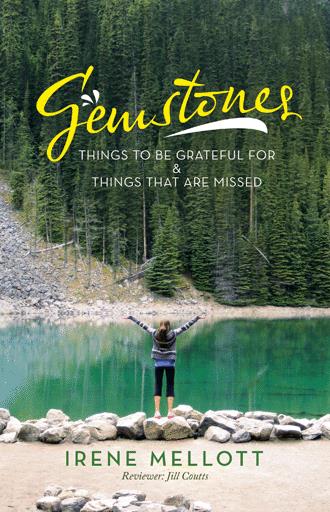
Gemstones
Things to be Grateful For & Things that are Missed
by
Book Cover & Preview Text
Chapter 1
Casey stomped on her shovel with her work boot, overturning another mound of dirt. “Of all the open spaces surrounding our home, why did you decide to pick this particular spot, Dad? This patch must have the largest deposits of rocks on our property!”
Her father leaned against his shovel, wiping his brow with his shirtsleeve. “Because I’ve always wanted a rose garden, and this is the perfect place.”
“No,” she parried. “Perfect would have been by the house where cultivated gardens already exist.”
“Is the work too hard for you?” he teased.
“As if! But, when you offered me a break from my studying, I didn’t realize I’d be swapping mental work for physical labour.”
Jeffrey chuckled at his eighteen-year-old daughter. “Perhaps you should have asked.”
“I overheard you tell Jason that you had to pick up supplies. I assumed that meant we’d be driving into town,” she said as she dug around the sides of a rock with her shovel until it had been worked free. Clutching it with both hands, she lifted it into the wheelbarrow, crash-landing on top of the others.
“Always check your assumptions,” Jeffrey breathlessly replied as he staggered under the weight of the stone he carried to the trailer. A resounding thud soon followed. “Your brother had offered to pick up the fuel pump needed to repair the excavator. I told him I’d be picking it up as I had some errands to run. The part you missed was when I’d be going into town - tomorrow.”
“Tomorrow!” she exclaimed, having thrown down her shovel. “Then why the manual labour? Once Old Digger is operational, it can find and dislodge these rocks so much quicker.”
“The mini excavator may be small compared to our other farm machinery, but its weight and tire type would tear up our lawn,” he replied, having returned to the section he was clearing.
Resigned to physical labour, Casey retrieved her shovel and changed the topic. “Is this going to become your new reading area?”
“Not new. Renewed. My reclining lawn chair is over there, leaning against the house. When you and the boys are at school, I often stop to take a break here, to watch the hummingbirds at the feeders, to read, to...”
“…snooze,” Casey chimed in.
“Ha! Yes, that’s happened a few times.” He released an involuntary sigh as he looked around. “It’s so peaceful here. I can envision the roses thriving and flourishing under the steady streams of sunrays, their splashes of colour a welcome addition to the bland landscape.”
“Roses are such high maintenance plants. Why not chose other long-flowering perennials instead, like alliums and daisies? Has it to do with Mom?”
“Not intentionally, but maybe on a subconscious level it does. Roses were her favourite as they continually bloom, their scents so varied, so strong. I’ve come to appreciate them as much as she did. As for the maintenance, we’ll plant some rose shrubs to cut down on the work, not that you need to worry about that end of things. This will be my hobby garden, and I look forward to nurturing it along.”
“Sounds like a lovely way to unwind,” she declared.
“You can participate whenever you’d like.”
“How very thoughtful,” she laughed. They carried on their work in silence, nature’s symphony providing the background music: the rustling leaves, the black-capped chickadee calling from somewhere deep within the woods, and the steady tapping by the resident pileated woodpecker.
Tugging at a stubborn thistle, Casey asked, “Why didn’t Grandpa like gardens?”
“What makes you think he didn’t?”
She shook out the soil from an uprooted thistle before pitching it aside. “Grandpa never worked them. Us kids did, and you and mom did, but not him. Why was that?”
“Your grandpa was a man full of disappointments. He could never see what he had; he only saw what he didn't have. He felt he lived on the land Jeremiah described.”
Casey bent over to pry loose a stone with her gloved hands. “Jeremiah?”
“Yes, the Book of Jeremiah verse 17:6 to be exact. Grandpa should have mounted it on a plaque for the living room wall, but I suppose living on this land was reminder enough.” Jeffrey rested an arm on the shovel’s handle as he recited the part of the verse that had been quoted to him over the years: He ‘will not see when prosperity comes, But will live in stony wastes in the wilderness.’” (NASB)
“But Grandpa didn’t live in such a place.”
Jeffrey smacked a hardened lump of soil with his shovel sending dirt in all directions. “I suppose he felt he was in a place similar to it. Grandpa viewed Rocky Meadows as worthless land, a stony waste. He tried selling it, but no one would buy it, not when there was lush farmland in the valley to be had.
“What about Great-Uncle Edward? Couldn’t he have bought it?”
“Probably, and it would have been the ideal solution, especially since his land was right next door, but he neither wanted nor needed it. Besides, his hands were full managing his own farm,” Jeffrey explained while simultaneously massaging his aching right arm. “My uncle was quite satisfied with the living he made from raising his livestock on his ‘stony waste’ of land, right up until his death. Sadly, no one could get your grandpa to see the prosperity he had.”
Casey looked over to where their cattle and sheep grazed on the rugged terrain. “And what do you see, Dad?”
Jeffrey motioned for his daughter to take a break with him. Together they walked towards the house, where he retrieved his lawn chair and unfolded it. Casey found a shaded section of grass to lie down on. “You were asking what I saw in this place,” he began, stretching out his tired limbs. “What I see is God’s hand on this land and us. Our livestock have plenty of grass to feed on, and they drink from the stream that flows through our property. We have several pens filled with chickens and pigs and a vegetable garden that fills our freezer and canning shelves. We have the security of owning a home. And surrounding our property are our wonderful farming neighbours. We want for nothing.” He reached for the water bottle he had placed under his chair. Unscrewing its lid, he took several sips of the ice-cold water, pouring some onto his bandana to cool his face and neck. “Do you remember the ceramic tile you painted in grade school?”
“Of course. I made it for Mother's Day,” Casey said, recalling the square tile trivet they used at mealtimes for hot dishes.
Jeffrey looked tenderly at his eldest child. “That’s right,” he said, briefly reflecting on the fact that five years had passed since his beloved had died. Oh, how he missed her. Her heart was always filled with joy, committed to gratitude even in times of adversity. And it infected all those she connected with. She was a living example of the bible verse: ‘for the joy of the Lord is your strength.’ (Nehemiah 8:10 NIV). Yes, she was strong, right to the very end. Refocusing his attention to the present, he asked: “Why do you think we still have it?”
She stared up at the cloudless, blue sky. “Because we’re extra careful with it.”
“Uh-huh. And we’re extra careful because we know it’s special. You made it with love and gave it with love, so we handle it, with love.” Jeffrey swept his hand before him. “This land is special to me. I love the memories it brings of your mom. I love it because I can raise my family on it. I love it because it reminds me of God’s goodness. Love is the key ingredient.”
Casey sighed as she pushed herself onto her elbows. “What I see are our cattle and sheep scattered across our rugged lands. And this dirt,” kicking the ground with her heel, “if you can call it dirt, is full of rocks!”
Formats

Book Details
About the Book
Gemstones
Things to be Grateful For
Casey tries to befriend a temperamental man adjusting to his new reality post-amputation. He, however, is not open to receiving visitors or unsolicited advice. But she’s persistent, resulting in outcomes that neither expected.
Things that are Missed
Hired to work at a Wellness Retreat Centre that caters to overweight women, Casey challenges her clients on their values and the societal norms that have influenced them. Her gemstone client continues to gain weight despite doing everything asked of her. She’s baffled by the mystery of what’s been missed.
This Christian fiction novel offers a small group study after each book’s conclusion. Investigate the potholes we find ourselves falling into and learn how to navigate out or around them. Journey with your small group on the road to spiritual transformation.
About the Author
Irene Mellott is a registered social worker. She resides in Edmonton, Alberta, Canada. This is her first Christian novel which includes a small group Bible study.