
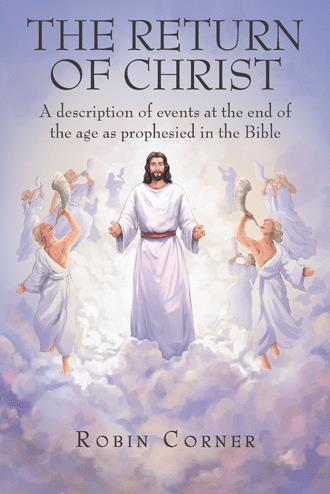
THE RETURN OF CHRIST
A description of events at the end of the age as prophesied in the Bible
by
Book Cover & Preview Text
Chapter 10: The development of differing views on the end times – apostolic church to Augustine
Here are eight basic positions, or systems of interpretation taken by different groups of Christians over the centuries. When we count likely combinations of views there are at least 13 possibilities.
1. Amillennialism (“Amil”) was, as I understand it, the original position of the New Testament, and was held by church fathers such as Dionysius of Alexandria and Augustine of Hippo, and reformers such as Luther and Calvin. The actual theological term, “Amillennialism” was only coined in the 20th century and would have been unknown to all these supporters, but the doctrine, I believe, fairly represents their known views. It takes its name from “a” meaning “no” in Greek – so it means “no millennium” – in other words, no literal reign over the world by Jesus from Jerusalem. Some writers prefer the term “realized millennialism” for the doctrine. It teaches that the millennial reign of Revelation 20 is the spiritual reign of the risen Christ during the Gospel era. Throughout this book we will shorten the term to “Amil” for easier reading.
2. The Classical Premillennialism of church fathers such as Papias and Justin Martyr. “Premil” derives from “pre” in Greek, meaning “before”. It teaches that Jesus Christ will come to earth before the millennium and will set up His reign over earth literally from Jerusalem for a literal thousand years. Many Premils claim that this was the majority position in the early church. Amil scholars do not at all accept that claim. We will refer to Premillennialism as “Premil”.
3. Historicism – This relates to the interpretation of the prophetic symbols of the Books of Revelation, Daniel, and certain other prophetic books. The historicist viewpoint is that the symbols represent historical events of the Gospel era, from Jesus’ earthly ministry to His return to earth. Historicism was born at the time of the Reformation, and, controversially depicts the beasts of Revelation 13 and 17 as the papacy, and the Roman Catholic Church. It is possible to be a Premil historicist, a Postmil historicist, or an Amil historicist.
4. Futurism – holds that the symbols of Revelation and other prophetic books have nothing to do with history but portray a time of future tribulation on the earth. Futurism was born from classical Premillennialism. For many centuries from Augustine onwards, it was very little heard of. It was revived by a Jesuit priest, Francesco Ribera, during the Counter Reformation.
5. Preterism – holds that the prophecies of Revelation and certain other books were fulfilled back at the time of the destruction of Jerusalem in 70 AD by the Romans, or earlier, and therefore do not address the world of our time. A person may be “full preterist” or “partial preterist”
6. Postmillennialism – (from the Greek “post’, - “after”) is the notion that Jesus will return after the millennium. The millennium as interpreted by Postmil is a golden age ushered in by the church, which, according to this theory, will triumph in its teaching and preaching to the extent that the world will be won and transformed even before the return of Jesus. When He arrives, the job will be pretty much done, according to this view.
7. Dispensationalism (including futurism and ‘pretribulationism’). Invented in the 1830’s by JN Darby, it was the first system to include the ‘pretribulation rapture’. The governing idea of the system is that God has different dealings with different peoples at different times so the Jews according to this theory have their own dealings with God separate from the church. Futurism is another tenet. Dispensationalism insists that the Book of Revelation portrays a future 7-year tribulation for non-believers after Jesus has come and removed all the Christians out of the earth. According to this view, people who miss the rapture will still have a chance to be saved during the tribulation.
8. Anglo-Israelism and similar – is focused on the northern ten tribes of Israel, which were forcibly exiled by the Assyrians in about 780AD. The southern tribes, Judah and Benjamin, ancestors of today’s Jews, were exiled by the Babylonians 150 years later. Anglo-Israelism holds that the northern tribes lost their identity and migrated to Europe, where they became modern-day peoples such as British, Dutch, Scandinavian, US and British Commonwealth.
The original Amil.
As we shall see, many modern opponents of Amil would dispute the title I have given this section. But it seems to me beyond any possibility of denial that the New Testament writers were Amil in their whole concept of the coming end of the age, the final judgment, the immediate reward for the believers, and God’s everlasting kingdom.
One fundamental concept of Amil is the progression from “inaugurated” truth to “realised” truth. This is seen particularly in the advance of God’s kingdom. One application of the concept is that Jesus totally defeated Satan at the cross. Satan is now a defeated foe. Jesus is Lord and King. But Jesus is not yet fully and visibly reigning. Mankind is still in rebellion, yet because of Jesus’ great victory, the issue is not in doubt. The victory has been won and Jesus’ reign has been “inaugurated”. But in time the reality of His rule will be fully “realised”. He will be visibly King of all the universe, surrounded with glory. This is not a strange doctrine to many modern Christians. I remember hearing the much-loved and respected Derek Prince comparing this victory of Jesus with the victory of the allies over Germany in 1944-5. Once the allies had landed on D-day, final victory was inevitable. In a sense they had already won the war – but this had to be fought through on the ground. Brother Derek was a convinced Premil Christian, but this aspect of Amil teaching would not have been strange to him.
Formats

Book Details
About the Book
At the time of writing, covid-19 is raging around the world and fears of global warming, war, economic collapse and famine are widespread. But is it possible that these things are signs of the long-awaited return of Jesus Christ as prophesied in the Bible? For the first time in history, the Christian Gospel is being taught in every nation on earth. Large numbers of people are becoming Christians in India, China, other parts of Asia, Africa and South America, even as in traditionally Christian countries, many are leaving the church. And if Christ returns as promised, what will that look like? What will be happening on earth? Robin was aware of many theories, so decided to research the issue himself, initially just by reading what the Bible has to say on it.
In this book, he looks at beliefs held over the centuries. He examines the scriptures and draws some surprising answers from many often-overlooked, simple passages. If you are new to this topic, you will find the book fascinating. And if you have studied it for years, be prepared to be surprised and challenged!
About the Author
Robin Corner is a New Zealand businessman, missionary and author who has a passion to see grassroots, transformational Christian movements multiply worldwide. He and his wife Margaret have travelled regularly to Kenya, to train local Christians to start home-based churches and discipleship groups and assist with the care of orphaned children through their New Zealand based charity, TEACH Charitable Trust. Robin holds a master’s degree in Christian ministry and is a strong believer in ecumenism. He and Margaret attend their local Catholic church in Kapiti Coast, New Zealand, and maintain connections with local and global house church movements. They have two adult children and two grandchildren.