
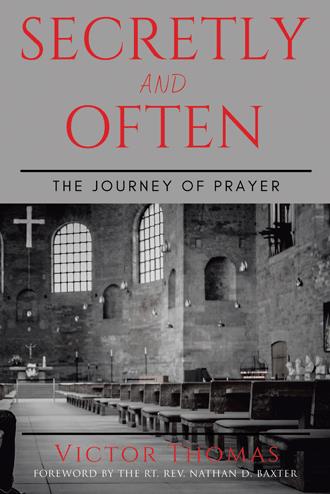
Secretly and Often
The Journey of Prayer
by
Book Cover & Preview Text
What Is Prayer?
The catechism of the Book of Common Prayer defines prayer as communication with God. Other definitions serve us well when we consider what prayer really is. Yet even in our best attempts to define it, we will never be able to explain prayer fully. Communication with God is only the tip of what prayer can be. The greater part of it remains hidden from our understanding, just as the largest and most dangerous part of an iceberg is hidden from our sight.
The theologian Leonard Sweet gave a good example of what happens in prayer. The thoughts of the mind can be detected in wavelengths. We are given an opportunity to interact with the mind of God and be on the same wavelength as the divine when we pray. Of course, Isaiah 55:8 says, "’For my thoughts are not your thoughts, nor are your ways my ways,’ says the Lord.” because his thoughts are on a higher and more meaningful level than ours. However, when we enter in prayer, we tune ourselves to the wavelength of God. For the narcissist, this attunement could be an opportunity to pontificate and become delusional. But for the sane and earnest, it is a humbling idea. The latter produces an experience absent of any self-exaltation and instead creates genuine thankfulness for the opportunity to communicate with the Creator of the universe.
Prayer is not only communication but also a spiritual disposition, one in which we develop and maintain divine reliance, openness, and genuine self-reflection.
The role of honest questioning and even doubt are rarely mentioned yet vital in prayer. Those who are truly dedicated to prayer experience periods of real doubts, during which they find themselves facing questions that are difficult to answer. When we embrace questions with the arms of faith, our thoughts are transformed and our souls flourish. Resolution even emerges in some cases. Conversation with God contains tension and the actual risk of unanswered questions. When a family member is suffering or a marriage dies, questions surface. In 2003, I sat before my television, horrified by the image I had just witnessed. A little boy, perhaps four or five years old, was playing alone on the beach. Out of nowhere, an enormous wave engulfed the child and swept him away. With my mouth agape in shock, I witnessed a tsunami’s destructive power. I was heartbroken. I’m not naïve; I have experienced as much as the next person and am aware of the many changes life can bring about. But as a father, the shock in that moment stayed with me. And it had me questioning.
I should not have been surprised by it because, theologically, I know the difference between moral and natural evil. Moral evil is committed by human beings through the volition of their wills. Hitler’s Holocaust of the Jews is a textbook example of a moral evil act. Stalin’s planned starvation and execution of entire communities meet the moral evil criteria. Pol Pot and the Khmer Rouge’s violent purge of all artists, teachers, and community leaders from Cambodia has moral evil written all over it. Finally, the most recent incarnation of moral evil is the terrorist organization known as ISIS, who continue to take a page from the medieval playbook of barbarism and sectarian hatred. These are the epitome of moral evil. Natural evil, on the other hand, involves acts of nature. A tornado that spins through a town, destroying everything in its path and stealing human lives, is an example of natural evil. We can label famine, earthquake, yellow fever, polio, and the recent outbreak of Ebola as other examples of natural evil.
Then there are times when moral and natural evil combine forces to cause destruction. Out of nowhere, an earthquake can hit, causing a house to collapse and killing its inhabitants. The death toll could have been less or eliminated altogether, but the builder had used subpar materials during construction, and no one had the courage to question his decisions. On Monday, May 14, 2008, a 7.9-magnitude earthquake rattled China’s southwestern province of Sichuan, causing the collapse of numerous schools and killing over a thousand students and teachers. There was no doubt about the natural evil’s role in it as an earthquake, but it was later found that moral evil was at work as well, in the form of cost-saving but corrupt building practices. Buildings should have been designed to withstand such an earthquake but were instead designed to withstand far less. There was no reason to have had such a large loss of life. Witnessing evil, whether natural or moral, to any degree can drive a wedge between a person’s desire to pray and their belief in the effectiveness of prayer.
Honest prayer embraces all this—the good and the evil, the apathy and the heartfelt commitment—and it turns it back to God. Real prayer says, “God, I remain in conversation with you about what pains and bewilders me. I will keep coming back to you with the questions I have about what I can’t explain or understand.” As my rector had mentioned in the beginning of the chapter, prayer is the process of faithfully coming to the prie-dieu (prayer desk) with regularity—not just when it is convenient. Thus, the difficulties and questions of life rub against our belief in a God who comforts and acts.
Formats

Book Details
About the Book
Prayer is the most essential gift for Christians because it’s the path to an intimate relationship with God. Without the practice of a prayerful living, how do you find your moral compass? In Secretly and Often, author Victor Thomas unpacks why you need to pray and discusses the different forms of prayer to enrich your experiences of talking with God.
In this guide, Thomas encourages you to rethink what it is to talk to the creator, and he underscores how prayer is more than rattling off desperate petitions in times of crisis. As he discusses the different forms of prayer—petition and supplication, praise, thanksgiving, confession, and penitence—he answers a host of questions, including: Why is intercession so important? How does giving thanks transform your prayer life? Why does perspective influence petition?
Secretly and Often shares the message that intimacy with God is always first and foremost. It serves as the base for all the activity that takes place in the life of Christianity. Prayer is the only road to intimacy with God.
About the Author
Victor Thomas was ordained an Episcopal priest in 1998 and serves as the rector of Saint James’ Episcopal Church, Houston, a Christ-centered parish with a deep commitment to community involvement and outreach. Thomas and his wife, Nicole, have three children.