
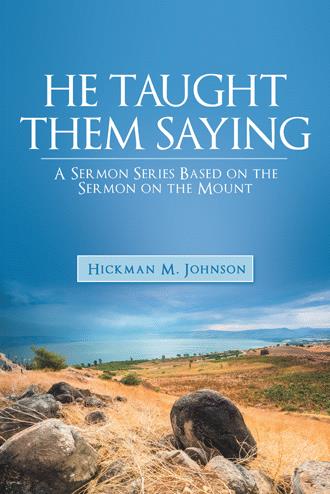
He Taught Them Saying
A Sermon Series Based on the Sermon on the Mount
by
Book Cover & Preview Text
LOVING OUR ENEMIES
In “The Sermon on the Mount,” our Lord has addressed those complicated issues of life. Jesus is not shy about dealing with earthy issues. He tackled the mundane: murder, anger, insults, slander, adultery, divorce and revenge. This new Moses has rewritten the law, and it is a new law— “But I say to you . . .” Unlike the old law which was written on tablets of stone, this new law is written on the hearts of men. This new law pushes human conduct to the limits and demands that the righteousness of kingdom people exceeds the righteousness of the scribes and Pharisees. But this new righteousness is not a slavish adherence to the letter of the law, but a devotion to the intent and spirit of the law. Jesus is not simply concerned with right actions. He is concerned with right will—right intent. Therefore, “right action” which is not motivated by “right will” can never be considered righteous. In the verses which follow, he now answers the lingering question that has been in the back of our minds as we have pondered these new laws and this extreme new conduct. What motivates kingdom people to live a righteous life? The answer is now clear!
“You have heard that it was said, ‘You shall love your neighbor and hate your enemy.’ But I say to you, Love your enemies and pray for those who persecute you, so that you may be children of your Father in heaven; for he makes his sun rise on the evil and on the good, and sends rain on the righteous and on the unrighteous. For if you love those who love you, what reward do you have? Do not even the tax collectors do the same? And if you greet only your brothers and sisters, what more are you doing than others? Do not even the Gentiles do the same? Be perfect, therefore, as your heavenly Father is perfect.” (Matthew 5: 43-48 KJV)
Up to this point what has been implied is now explicit! Love drives this new fellowship to be godly. If they (we) are to be the children of God, then they (we) must love those who are most unlovable—our enemies. Love our friends? Even tax collectors and Gentiles love their friends! Our righteousness must exceed the righteousness of the tax collectors and Gentiles. Loving those who love us cannot be the test of our godliness. If we would be godly, then we must love our friends and our enemies. “…for he makes his sun rise on the evil and on the good, and sends rain on the righteous and on the unrighteous.” The sun does not shine only on the good. The sun shines on the good, the bad, and the ungodly.
For most of us, enemies are real but are faceless and nameless. If asked to name three enemies, most of us would be hard pressed to name them. Name three enemies; three people who would delight in your personal defeat; three people who are engaged in your personal destruction? Three people who are waging a campaign of character assassination; three people who hate you with a vengeance? Three people who have undermined your influence; who slander and malign your good name; who told vicious lies about you and who kept the rumor mill running full time? Three people, if you were hungry or thirsty, would not give you food or drink? In other words, can you name three enemies? For most of us, our enemies may be real, but they are nameless and faceless—an abstraction. We rarely make enemies intentionally, while friends are cultivated; an intentional act. The fear of loneliness forces us to make friends. Some of us will do almost anything to hold fast to a friendship; to be accepted and included in the group. A few of us will even sell our souls to the devil, if it means we can escape rejection. Therefore, while enemies are a reality, they are not our reality since we are consumed by the passion to make friends, not enemies.
But for the disciples of Jesus and the early Church enemies were not an abstraction, but a real and present danger. They sought to kill the disciples and to destroy the Church. If we modern believers have not made enemies, it is because we have not challenged wrongdoing. If we modern believers have not made enemies, it is because we have not condemned evil. If we modern believers have not made enemies, it is because we have not opposed corruption. If we modern believers have not made enemies, it is because we have not condemned sin. The early church was guilty of challenging, condemning, contesting, and confronting and it became an object of scorn and suffered a bloody fate at the hands of its enemies. To be accepted and celebrated is to lose our prophetic witness. A popular Christian is an oxymoron. Prophets were never popular, and if we share the prophetic witness, then we will never be popular. Indeed, vilification and death are the prophet’s rewards.
I confess that when I was a young pastor, I wanted so much to be loved and respected by those whom I served. I tried to live right and do all the right things. I was concerned about public perception, realizing that perception is reality, even if that reality is unreal. I was respectful and courteous to my elders. I went out of my way to aid those in distress. At night, I interrupted my sleep to befriend strangers. I gave food to those who were hungry and clothes to those who were without. I did not beg or borrow from those I served. I gave my time gladly to social activism. I sought to be a change agent, believing that I had to make a difference in the quality of life for the poor and the disinherited. I committed my life to the political and economic empowerment of the masses. I was idealistic and hopeful. I realized that no object could ascend a hill where there is no friction. Friction is the creative energy for advancement and without it, failure is inevitable. It was not long that I made enemies: enemies in the church, enemies within religion, enemies in politics, enemies within the community. There were those who envied my success and were jealous of my accomplishments. There were those who were greedy for gain and coveted what I had created. For reasons I will never know, the young pastor had discovered that while he had wanted to earn the love and respect of those whom he served, he had nevertheless gained as well, the contempt and envy of those whom he served. It was a double-edged sword: love and hate; respect and contempt. The years would come and go and the young pastor would grapple to understand what wrong he had done to those who were now his enemies. Had he unwittingly wronged them? Had he failed to befriend them? Had he badly mistreated them? He searched his memory to find recorded therein a record of his misdeed. Should there not be regrets? And yet he found none. Of course, there were the things he had wished he had not done. But how did these lapses in judgment harden his enemies against him, since they did not relate at all to any mistreatment or maltreatment the enemies might have received? The young pastor struggled to make sense out of his actions. He was vilified and ostracized. He was criticized and crucified. He was condemned and slandered. Troubled by the intensity and frequency of these assaults, the young pastor wanted reconciliation, but reconciliation was elusive. But then, without searching, reconciliation knocked on his door in the form of a telephone call: when a man who had done the young pastor great harm, called to apologize for the injury caused him. The young pastor listened and was deeply moved to tears, when an enemy asked his forgiveness. Little did the young pastor realize that the enemy was facing his last earthly hours as he granted absolution for past wrongdoings.
Formats

Book Details
About the Book
He Taught Them Saying is a sermon series based on the Sermon on the Mount.
The Sermon on the Mount was not preached to the masses but to the twelve—those whom Jesus called to follow him. It remains the most significant body of ethical teachings found in the Gospels.
Hickman M. Johnson, a longtime pastor, explores the savior’s sermon in detail in this book, noting that Matthew introduced us to this event by saying: “And seeing the multitudes, he went up into a mountain: and when he was set, his disciples came unto him: And he opened his mouth, and taught them, saying …” (Matthew 5:1–2 KJV).
The disciples pondered the meaning of his words, grappling with their significance to this new life. They and we will ask questions like:
What does it mean to be Christian?
How are we Christians to live?
How are we to reflect Christ in our lives?
If the Ten Commandments established the moral norm for ancient Israel, then the Sermon on the Mount sets the ethical standard for Christian believers.
About the Author
Hickman M. Johnson is a graduate of Tennessee State University (B.S.), Morehouse School of Religion, The Interdenominational Theological Center (M.Div.), Mississippi College (M.A.), and Emory University (D.Min.). He was awarded the honorary doctorate (D.D.) from Mississippi Baptist Seminary. He has served as pastor of the historic Farish Street Baptist Church, Jackson, Mississippi, since 1968. He formerly served as chaplain, Tougaloo College, academic dean, and president of Mississippi Baptist Seminary. He is married, has five daughters, and eight grandchildren. He is also the author of Farewell My Friends.