
The Revelation
A Historicist View
by
Book Cover & Preview Text
PART 3
Opening of the Seven Seals
The First Horseman: A Literal Translation of Revelation 6:1-2
And I saw when the Lamb opened one of the seals; and I heard one of the four living creatures saying with a voice like thunder, Come and see. 2And I looked, and behold, a white horse. He who sat on it had a bow; and a crown was given to him, and he went out conquering and to conquer.
Things Prophesied
In Revelation 5, we are told that the Revelation can only be opened by the coming of Jesus, the Lamb of God. The history books tell us that the second coming was in AD 312, when the sign of Christ appeared in the clouds, i.e., a chi-rho, and Jesus appeared to St. Constantine and said, “By this, conquer.” And that is what Constantine promptly did. First, he put the sign on his labarum and on all of his army’s armor. Then he mounted his white horse, and carrying a bow, he conquered Rome and all the known world for Jesus.
There will probably be some Christians who say, “But there was no rapture.” Instead of Paul’s “rapture”, Constantine sent his messengers with a trumpet and gathered the elect of all the Church together, to Nicea, just as prophesied by Jesus in Matthew 24:31. All attendees said they felt as though they were in heaven.
The history books say that the appearance of the sign of Christ in the clouds on October 27, AD 312, marks the turning point of history because ever since that day, Christian nations have been the dominant force on Earth. That is what Jesus came to do—to rule the Earth through His followers. (In Luke 19:27, Jesus makes it clear that He does not kill anyone upon returning with a kingdom, and His followers are to do the killing of all His enemies).
We should note that the first horseman is introduced by the first of the four living creatures that are first seen in chapter 4. They represent the four Churches that have given us the four Christian superpowers (or horsemen) that have ruled the Earth for the last seventeen hundred years. The first one, the lion, represents either the Orthodox Church or, more likely, the entire Church when all the Church was united as one. That allowed the early Church to roar like a lion for a while—until most of the Antioch Church and the Alexandria Church split off in the 5th and 6th centuries, and were subsequently conquered by the seventh head of Satan (i.e, the Islamic hordes).
That is a traditional historicist view of the first horseman.1
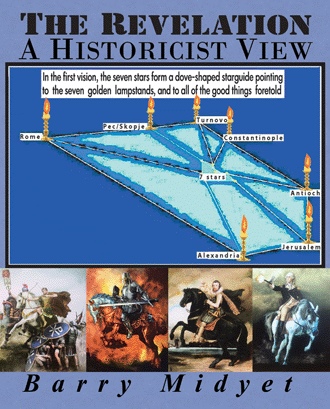
Constantinople is pointed to by the star guide of Revelation 1 which guides the reader to all of the good things foretold.
At least one of the over 100 editions of the Geneva Bible (carried by the Puritans on the Mayflower) has a running commentary on the Revelation in the margins which says Constantine was the first horseman. This commentary is intended as an update of the 16th century historicist view, showing all of the things that have been fulfilled since then.
For Further Study: When did Constantine become a Christian?
There will probably be some who say Constantine was not a Christian or that he did not become a Christian until he was on his deathbed. But the Greek Orthodox Church says he converted and became a Christian that day when he saw the sign of Christ in the clouds and again in a dream a bit later (when Jesus appeared to him). At that point he became what the Greek Church calls “a Christian in training” when translated into English. It is true that he was not baptized until much later, but it was not because he did not want to be. He had to graduate from training class first.
The Second Horseman: A Literal Translation of Revelation 6:3-4
And when He opened the second seal, I heard the second living creature saying, Come and see. 4And another horse, fiery red, went out. And it was granted to the one who sat on it to take peace from the earth, and that they may kill each other; and there was given to him a great sword.
Things Prophesied
The five horsemen of the Revelation can be thought of as five dispensations of the second coming. Following the Byzantine Empire, the second horseman to rule the Earth for Jesus was Roman Catholic kings who conquered with a great sword, and took peace from the Earth with their Crusades—when they did manage to kill some enemies of Jesus in the Holy Land as intended, but they also tended to kill everyone in sight, including Jews and even other Christians. It can truly be said that they took peace from the earth.
The kings and knights of the Middle Ages generally rode stout red (or chestnut-colored) horses with Arabian blood that are better able than white horses to support the added weight of the knight’s heavy armor. Plus, the stouter Arabian horses added some extra force behind the thrust of their great swords (or lances).
The living creature that introduces the second horseman is the calf, which obviously represents the Roman Catholic Church because it gave us the Roman Catholic kings, but it is not very flattering. A calf has virtually no prowess or conquering abilities.
The Pope and many of the capitals of the Roman Catholic kings are pointed to by the star guide of Revelation 1.
The Third Horseman: A Literal Translation of Revelation 6:5-6
And when He opened the third seal, I heard the third living creature say, Come and see. So I looked, and behold, a black horse, and he who sat on it had a pair of scales in his hand. 6And I heard a voice in the midst of the four living creatures saying, A quart of wheat for a denarius, and three quarts of barley for a denarius; and do not harm the oil and the wine.
Things Prophesied
The third horseman to rule the Earth for Jesus was Great Britain, which was founded by King James who rode a black racing horse for which England is famous.
The British Empire is also famous for conquering with economics. It was the Brits who invented capitalism. And they formed and sent companies all over the world to exploit new lands and make money for the king. And they rarely had to fire a shot, and it is truly amazing. It is true that a quart of wheat for a denarius would have been a very expensive price for wheat in the first century, and some therefore say it indicates famine. But we should remember that Jesus is predicting prices in the 17th and 18th centuries, and the price does not indicate famine as much as it indicates inflation and the ability of the British to get top dollar for their products and services.
The Anglican Church which gave us the British Empire is represented by the third living creature which is said to be a man. It is probably meant to reflect, or signify, the enormous increase in man’s knowledge during the reign of the British Church.
Both Canterbury and London (the Anglican lamp and stand) are pointed to by the star guide of Revelation 1 which guides the reader to all of the good things foretold.
Formats

Book Details
About the Book
As everyone knows, a theory can only be proven by its ability to predict things. That applies to eschatological theories as well. Every year in recent years, hundreds, if not thousands, of predictions have been made by famous eschatologists, like Hal Lindsay et al., and very rarely does one of them come to pass. So obviously, all their wild theories are false, and it is the main reason the world laughs at Christians. This book aims to change all that and to prove to even the most hardened atheist that God is real and is a time traveler of some sort who, over 1900 years ago, accurately predicted all of the earthshaking events that have occurred since then.
About the Author
Barry Midyet was born in a small town in the heart of the Texas Bible Belt. As he likes to say, he was baptized by a Nazarene minister in a Baptist church as a teen, and later, just to be on the safe side, he had it confirmed by an Episcopalian bishop. For twenty-five years, he worked as an electronics/computer technician, and since 1992, he has devoted his time to studying the Revelation and also making predictions based on it that for 25 years have always come true.