
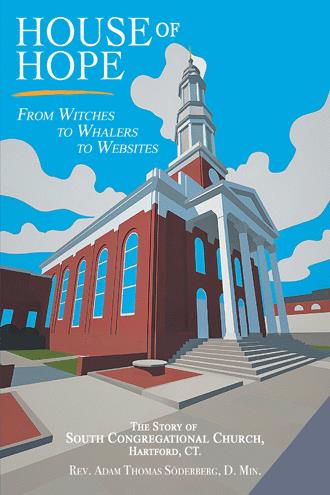
House of Hope From Witches to Whalers to Websites
The story of South Congregational Church, Hartford, CT.
by
Book Cover & Preview Text
They drank cider, beer, syrups, and cordials which they made themselves; imported rum and wine, as they could afford, and, under regulation of law, smoked tobacco which they grew themselves. Early Connecticut colonists acquired from the Native Americans the habit of smoking tobacco in pipes and began cultivating the plant. Today, the Connecticut River valley north of Hartford is known as “Tobacco Valley,” and Windsor tobacco leaves (known as “Connecticut Shade”) are highly prized by fine cigar makers. Except for using the skins of deer, raccoon, wolf, and beaver, they sent what they grew to Boston and traded it for cloth to make their clothing. Connecticut farmers were growing wheat, rye, barley, peas, Indian corn, hemp, and flax. They also made cider, perry (a fermented beverage like cider made from the juice of pears), pine boards, and staves. No ports of the colony were free, and little was brought to them from abroad. Now and then, a shipment was made to Barbados or other Caribbean Islands and bartered there for sugar, cotton, wool, and rum. Occasionally, a vessel would sail to Madeira or Fayal (Portuguese Islands) and return with wine. In 1680, there were about twenty small merchants in the colony. There were few servants and even fewer slaves; not more than thirty in the entire colony. Now and then, a ship from Barbados would bring back a black man or two. Such were sold at the rate of about 22 pounds ($86.00) each. There were four or five Seventh Day Adventist men in the colony and about as many Quakers. The Quakers had been harshly discouraged from settling here. Money was scarce and labor dear. Laborers were paid two shillings (.50¢) a day. Wheat was four shillings (.30¢) a bushel, pork and beef about three pence (.05¢) a pound, and butter brought sixpence (.10¢). They were poor people. One commonly discovered that a year’s labor tilling the ground and gathering some small portion of provision from it, after it was transported to Boston, would purchase a half a crown’s (.21¢) worth of goods that could be bought for tenpence (.17¢) in England. Storms, mold, and mildew damaged their wheat. Strange worms devoured their peas, and conflicts with the Indians left them heavy in debt, but hearty people they were who endured under such heavy burdens. Like the people of the day, they had their superstitious notions and trials. The appearance of comets in the sky created alarm in many minds, and even the ministers regarded such appearances with apprehension, connecting them with visitations of drought, war, and pestilence. Occasionally, a house would be harassed by demons. Strange disturbances and noises would occur. Some thought they could be explained by natural causes, but others believed it was due to Indian sorceries and devilish enchantment, of which a great collection of stories was on hand. A physician, if he were a keen student of natural things and not particularly pious, might acquire the reputation of a wizard, and his friendly interaction with the Indians. Intent on studying their character and customs would expose him to the suspicion of many, as if he were in an unholy alliance with heathen conjurors.
Formats

Book Details
About the Book
South Church was founded one hundred and six years before America became a country. As a result, our history includes everything from old superstitions to social media. We witnessed witch trials, a Revolution, professional sports teams, and the creation of the internet. A lot has changed in three hundred and fifty-five years, but, through it all, we have remained a House of Hope on Main Street in Hartford, Connecticut.
About the Author
Dr. Söderberg is a graduate of American Christian College and Seminary (B.A.), Bangor Theological Seminary (M.Div.), and Luther Rice College and Seminary (D.Min.). He has served as a pastor since 1997 and was called to be the sixteenth Senior Pastor of South Church in 2006. Adam married his high school sweetheart, Renée, in 1981, and they have three grown sons and two grandchildren.